A robot dog on its own is a platform looking for a job. What decides whether it earns its keep is what it carries, how the data gets back, and who keeps it running after the novelty wears off. We configure the whole system — the quadruped platform, the payload stack, the control software and the service behind it — so your team receives a working inspection tool instead of a machine that needs a project.
WillFly Drone has been building payload systems for unmanned platforms since 2016: solar panel cleaning, precision seeding, aerial firefighting. The same engineering now goes onto ground robots, for sites that need a machine on the floor rather than in the air.
Where It Works
Power and energy
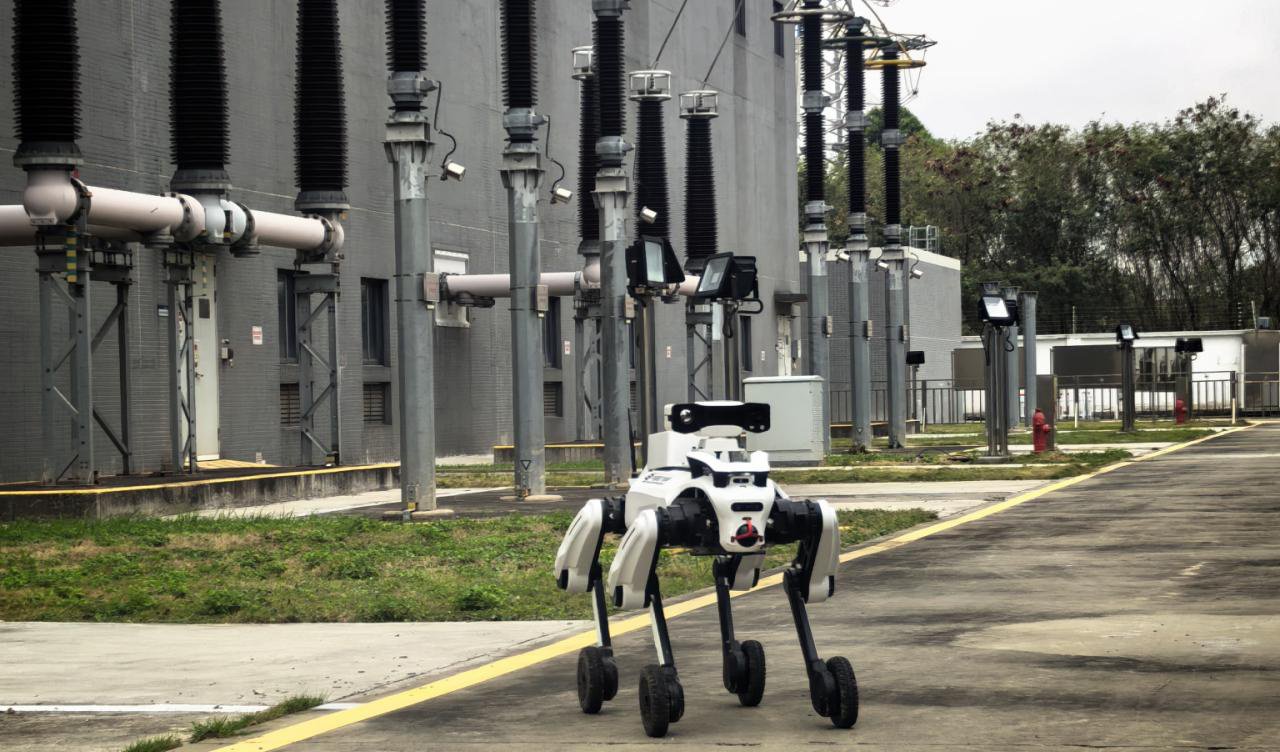
Substations, cable tunnels, converter stations and plant perimeters. A thermal gimbal picks up hot joints, loose clamps and failing equipment before they trip anything; the same route gets walked every night, in the same order, with the readings logged. No overtime, no weather excuses, no argument about whether the 2 a.m. round was actually done.
Industrial parks, plants and commercial sites
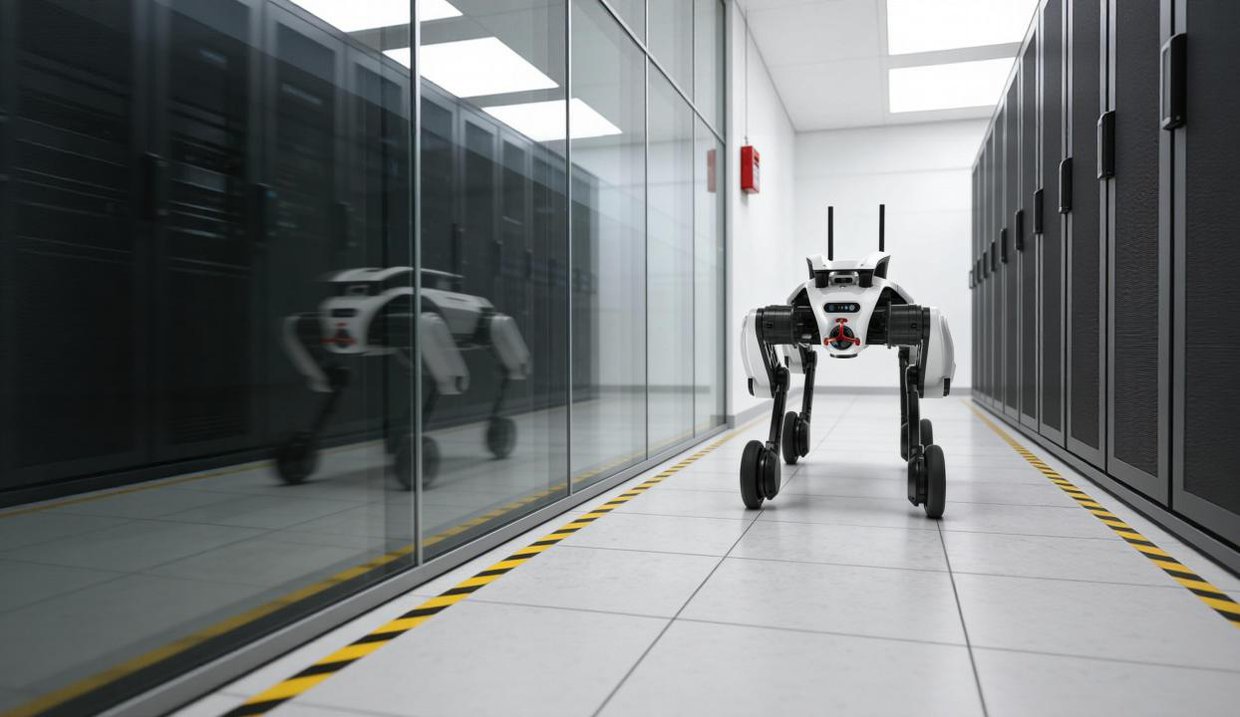
Scheduled patrols, perimeter checks, meter reading, night-time thermal surveillance, and crowd guidance when a site gets busy. Red and blue beacons plus a 120 dB speaker let one operator handle from the control room what used to take two guards on the ground — and every patrol leaves a video trail that stands up after an incident.
Emergency and fire response
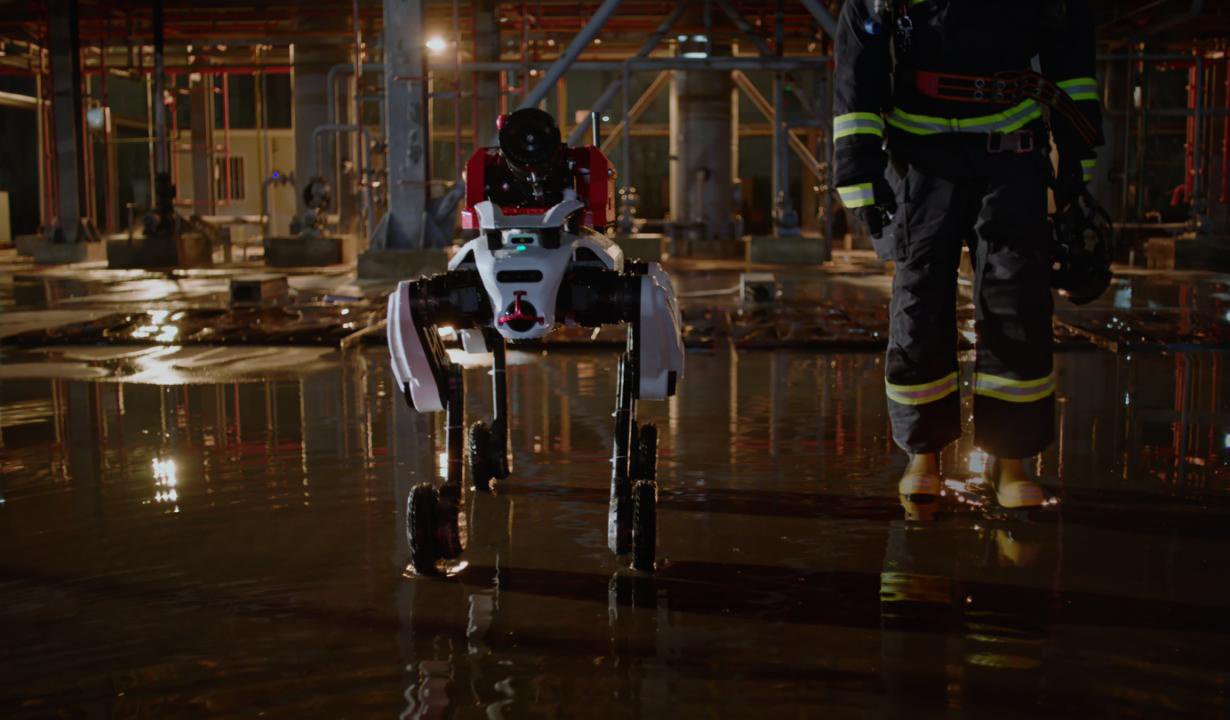
Send the robot in first. It climbs stairs and rubble, works through smoke and heat, and streams video from inside a structure that is not safe to enter — so the crew knows the layout, the fire seat and the location of anyone inside before they commit. With a water monitor mounted, the same unit can start knocking down a fire while people are still setting up.
Forestry, agriculture and remote outdoor sites
Rough ground, steep slopes, long distances — where legs beat wheels and where nobody wants to send a person at night. Set GPS routes and the unit works through plantations, orchards, storage yards and boundary lines on its own, reporting what changed since the last run.
The Payload Is the Product
One platform, several missions, swapped in minutes. The payload set we configure most often:
Dual-spectrum PTZ gimbal — visible and thermal in one unit, 30× optical zoom on the visible channel. The same patrol identifies a person at night and a 5 °C temperature rise on a terminal.
All-in-one response module — 120 dB loudspeaker, 1,000-lumen searchlight, red and blue beacons with 16 flash patterns and two-way audio, in a single under-1 kg unit. Warn, talk back and record from one screen.
Robotic arm — six-axis, for opening doors, turning valves, picking up samples and pressing buttons a robot should press instead of a person.
Gas detection module — combustible gas, H₂S, CO and O₂ in one head, with alarms pushed to the control platform rather than to a handheld unit nobody is holding.
Firefighting monitor — water or foam cannon with remote aiming, for vehicle fires, tank farms and warehouse interiors.
Autonomous charging dock — the difference between a demo and a 24/7 patrol. The robot returns, docks and resumes the schedule by itself.
Net capture module — launches a 9 m² net at 8–10 m with laser aiming, for containing a suspect at a station, square or airport without closing to contact distance.
Need something that is not on the list? That is our home ground. We have spent a decade mounting cameras, sprayers, seeders and firefighting equipment on drone platforms; putting your sensor on a quadruped is the same engineering problem — power, data, weight, centre of gravity. Send the datasheet and the mission, and our engineers will confirm fit before you order.
Two Platform Classes
Start from the weight the robot must carry and the environment it must survive. Two classes cover most of what buyers actually need:
| Specification | Patrol class | Heavy class |
|---|---|---|
| Best for | Site patrol, security, substation and plant inspection | Fire rescue, forestry, heavy payload work |
| Payload | 40 kg walking / 120 kg static | 80 kg continuous / 200 kg max |
| Endurance | 6 h | Over 8 h without payload |
| Protection | IP67 | IP67 |
| Operating temperature | −20 °C to +55 °C | −20 °C to +55 °C |
| Stairs and obstacles | 25 cm stairs, 100 cm obstacles | 25 cm stairs, 90 cm obstacles |
| Slope | 45° | 45° |
| Top speed | Up to 8 m/s | Up to 7 m/s |
| Payload slots | All modules, standard | All modules, standard |
Figures are typical for the platforms we supply. The exact model and configuration are confirmed at quotation, against your mission profile and budget — including the option of integrating on a platform you already own.
Air and Ground, One Inspection Loop
Drones and ground robots are not competitors; they cover different geometry. A drone sweeps a 200-hectare solar farm in half an hour and finds the row with the hot string. It cannot open the inverter door, go into the cable trench, or stand watch at the gate at three in the morning. The robot does exactly those things — slowly, closely, repeatedly.
Run them together and the workflow closes: the drone screens the site and flags the location, the robot goes in for the close-range thermal image, the gas reading or the meter reading, and both feed the same report. One supplier, one service contract, one set of spare parts.
For solar sites we already clean, this is the cheapest expansion available: the panel cleaning system protects yield, the ground robot protects the assets that produce it. Same site, same contact, second workflow.
What You Get
A standard order includes the robot, the operator controller, batteries and charger, the payloads you specified, and a basic spares kit. Operator training is included, online or on site, and every unit carries a 12-month warranty with spare parts support.
Delivery: 30–45 days depending on configuration and payload
Shipping: sea freight by default (UN38.3 lithium battery compliant), air freight on request
Spares: recommended kit at roughly 10% of unit value, quoted separately so you can see what you are paying for
Support: remote commissioning, English documentation, 12-month remote technical support, paid service beyond that
Export: we handle the documentation for your market, including the certificates your customs authority asks for
Why Source From WillFly
We are a payload engineering company, not a trading desk. Since 2016 we have designed and manufactured drone payload systems — cleaning, seeding and firefighting modules — delivered to customers in more than 30 countries, over 1,000 units in the field. That history is why we treat the robot as a carrier and the payload as the product.
The same platform thinking runs through our other line: the WillFly AI Box turns existing surveillance cameras into a 24/7 alert system, and it talks to the same reporting layer as the robot. OEM and ODM configurations are available for distributors and fleet operators.
Questions Buyers Ask
Which brand is the robot?
We work with several leading quadruped manufacturers and select on payload capacity, runtime, IP rating and price for your mission. The platform is confirmed in the quotation. We are platform-independent: if you already own a robot dog, we can integrate the payloads and software on it instead, subject to a compatibility check.
Do you sell the robot on its own?
Yes, we can. Most customers do not buy it that way — they take the platform, the payload stack, the training and the spares as one package, because a bare robot with no payload and no local support tends to sit in a corner after the first month. Tell us the mission and we will quote both options so you can compare.
Can you integrate our own sensors or equipment?
In most cases, yes. Share the datasheet and the mounting requirements, and our engineers will confirm power, communication and space compatibility before you order.
What does after-sales support look like from overseas?
12-month warranty, spare parts supply, remote technical support and operator training. Consumables and wear parts are stocked and shipped on request. For fleet customers we agree a response time in the contract rather than leaving it to goodwill.
How long does delivery take?
30–45 days from order confirmation, depending on platform class and payload configuration. Sea freight adds transit time to your port; we quote it separately so you can plan the site works.
How do we get a quote?
Send your site type, patrol area, inspection targets and delivery market through our contact page. We confirm the configuration and return a quotation within one working day.
Related reading: how our payloads support high-rise maintenance · solar panel cleaning in desert climates
Building a full-site inspection program? Pair aerial drones with our Ground Robotics & Inspection Solutions.