Solar Panel Cleaning in Desert Climates
In much of the Middle East and North Africa, solar power is the obvious energy bet: huge open land areas, relentless sun, and rising electricity demand. The same climate, however, delivers one of the harshest soiling environments on earth. Field studies across the Gulf and North Africa consistently show that a solar plant in a desert climate can lose a fifth or more of its annual yield to dust alone if cleaning is left to chance.
This article looks at what desert dust actually does to PV modules, what the measured data says, and how to build a cleaning schedule that makes economic sense — including where drone-based cleaning fits, and where it does not.
Why Desert Dust Is a Different Problem
Dust in temperate climates sits loosely on glass and mostly waits for rain. Dust in desert climates behaves differently, for three reasons:
1. Sandstorms deliver in hours what other climates take weeks to deposit. A single storm can blanket an entire plant with fine mineral particles overnight, and the fallout keeps arriving for days as suspended dust settles back out of the air.
2. Humidity cements the dust in place. This is the mechanism researchers call cementation. Overnight dew and coastal humidity wick into the dust layer; minerals such as calcite and gypsum bind it into a hardened crust. The Qatar Environment and Energy Research Institute (QEERI), which ran a five-year soiling test program in Doha, found that dust, heat, humidity and salinity combine to form exactly this kind of cemented layer — and once it hardens, ordinary light rain will not remove it.
3. Anti-soiling coatings have not solved it. QEERI tested 84 anti-soiling coatings and glasses over the same program. None reduced soiling "significantly, consistently and durably." Coatings may reduce cleaning frequency at the margin, but no plant in a desert climate should count on glass treatment as a substitute for washing.
Add near-flat tilt angles — common on large ground-mounted plants, and notorious for forming mud rings along the module edge — plus bird droppings that never wash off on their own, and the picture is clear: desert soiling is an aggressive, compounding problem that demands an active cleaning program.
What the Data Says: Soiling Rates in Hot, Dry Climates
The measured numbers are worth taking seriously, because they are far larger than most operators assume:
QEERI, Doha (five-year field test, 81 technologies): dust accumulation reduced energy output by an average of 0.49% per day — roughly 15% of production in a single month without cleaning. The research team's own comment: "The impact of dust is underestimated."
NREL data for Middle East sites: annual soiling losses of 20% or more where plants are not cleaned — the lower bound for locations such as Abu Dhabi and Riyadh.
Published review literature: daily soiling losses range from about 0.01% per day in Europe to 1–2% per day in particularly arid regions of MENA and East Asia. The same literature recommends nearly tripling the assumed degradation rate for desert-installed modules versus the standard warranty figure.
The compounding is what hurts. At 0.5% per day, every month of delay costs about 15% of that month's energy — and in a plant selling power under a fixed tariff, that is revenue that never comes back.
How Often Should Desert Plants Be Cleaned?
There is no single answer, but field data and O&M practice converge on ranges like these:
| Site environment | Typical loss if uncleaned | Practical cleaning cadence |
|---|---|---|
| Gulf coastal desert (high humidity, cementation) | ~0.5% per day; 15%+ per month | Every 3–4 weeks |
| Inland desert, dry sand, low humidity | 0.3–0.5% per day | Every 1–2 months |
| Desert fringe near farms, roads or industry | 0.5–1%+ per day | Every 2–4 weeks |
| After a sandstorm | Sharp single-day spike on top of the base rate | Inspect and clean as soon as practical |
QEERI's economic analysis adds a useful rule of thumb: with mid-range module efficiency, labor costs and power prices, the optimal strategy was to clean when soiling losses reached around 10% — which in Doha conditions worked out to roughly 8–13 cleaning cycles per year. Treat these as starting points and let plant data overrule the calendar: if your performance ratio drops well below its weather-corrected baseline, the panels are telling you it is time. For sites in milder climates, the logic changes — see our separate guide on how often solar panels should be cleaned.
The Water Question
Deserts are precisely where water is scarcest and most expensive to deliver. Conventional truck-and-crew washing of a utility-scale plant consumes large volumes, and much of it simply runs off between the rows. Any cleaning method for desert sites should therefore be judged on water discipline, not just on cleaning quality.
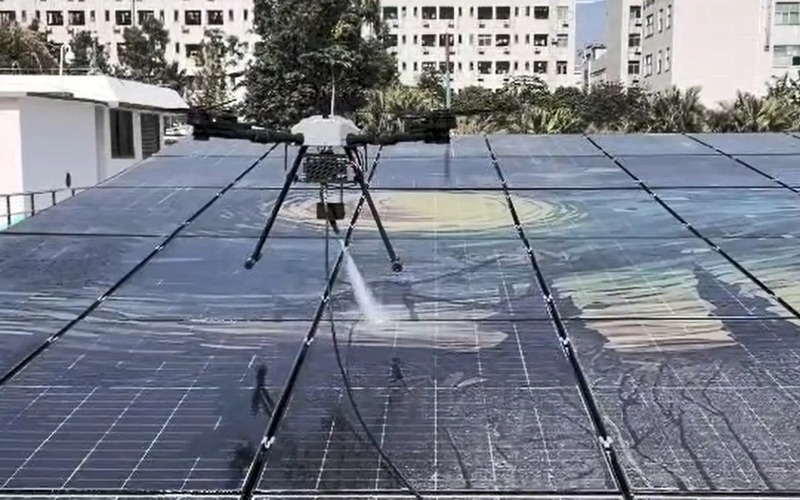
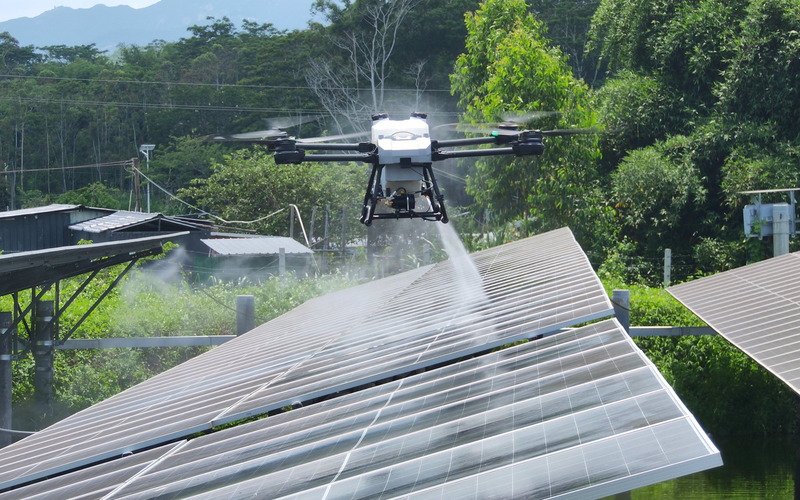
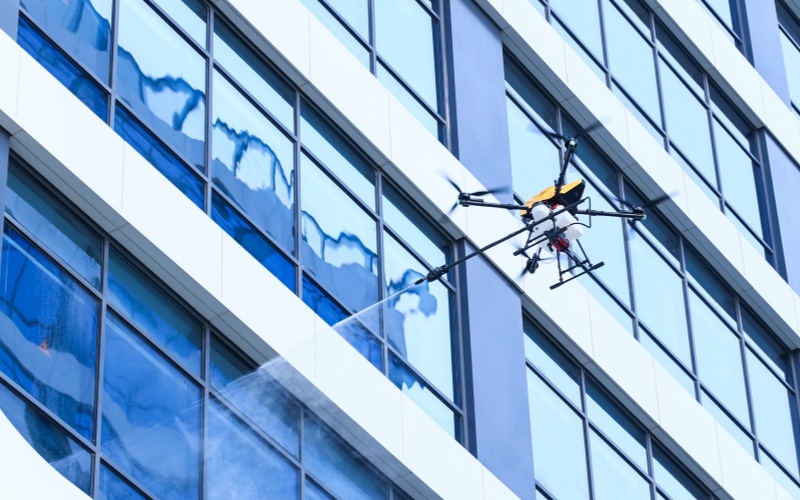
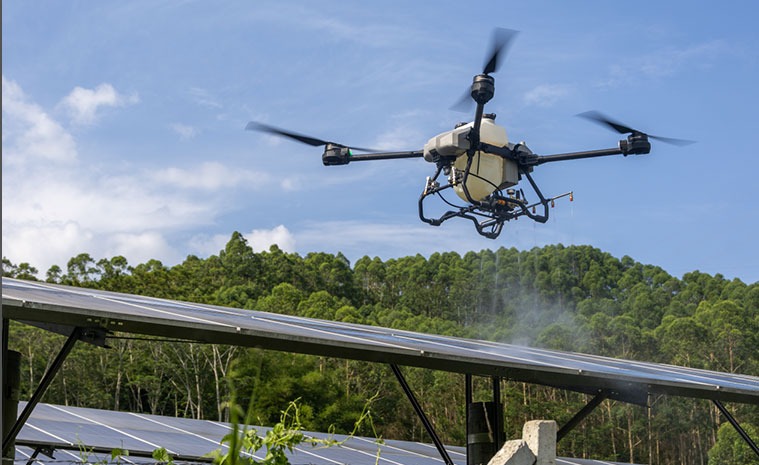
Drone-based cleaning helps on both counts. The aircraft carries water up in an onboard tank — typically around 80 liters per sortie — and applies it through an adjustable, targeted spray over the glass, rather than flooding the whole array. Flow rate is electronically controlled (about 5–20 L/min on the system we build), so the operator matches water use to how heavily soiled each section actually is. Ground crews stay off the modules entirely.
One honest caveat: drone cleaning reduces water waste, not the need for supply. A remote desert plant still needs water trucked in and stored on site — the difference is that far less of it is needed per cleaned square meter, and no scaffolding, lifts or roof-walking crews are involved.
How Drone Cleaning Works on Desert Sites
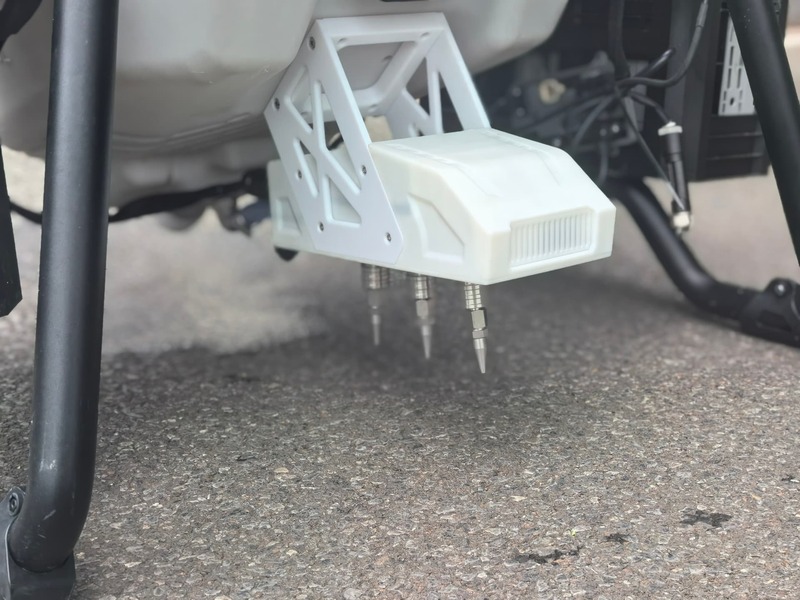
The working setup is a lifting drone platform with a purpose-built spray module mounted underneath. Our FC100 solar panel cleaning payload is designed exactly for this job, and the matching PV cleaning module carries the hardware:
— Low-pressure twin-pump spray, 10–15 MPa. High enough to strip cemented dust; low enough to stay gentle on module glass and seals. Pressure and flow are both electronically adjustable from the ground.
— Three-nozzle spray head with 0°/15°/25°/40° options and a 5–65° oscillating spray bar. The angle adapts to tilt angle and row spacing, so the jet reaches the glass surface evenly instead of blasting one strip.
— About 80 L onboard water, module under 8 kg excluding the tank. The payload mounts on the FC100 platform with a quarter-turn quick-release, so one aircraft can switch between cleaning and other missions in minutes.
— No contact with the modules. Nobody walks on the panels, so there are no boot-induced micro-cracks, no uneven shading from scuffed surfaces, and no fall-protection paperwork. For desert plants with thousands of identical rows, the drone simply works its way along the strings.
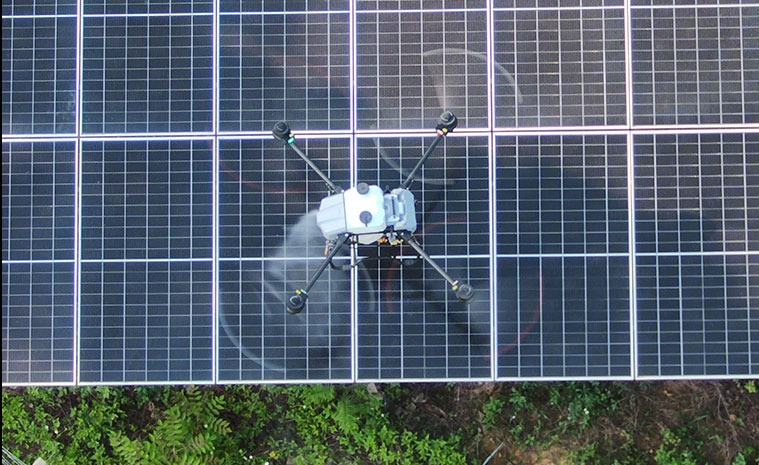
For operators comparing full-service approaches, our overview of solar panel cleaning solutions explains how the drone method stacks up against manual and robotic alternatives.
An Honest Note on the Limits
Drone cleaning is not a magic answer for every desert site, and it is worth being plain about the constraints:
Extreme heat windows. When ambient temperatures push past the mid-40s °C, lithium batteries and payload electronics work harder and flight times shorten. The practical pattern in Gulf summers is to fly early morning and late afternoon — which also suits the panels, since spraying cold water onto glass at peak thermal load is best avoided anyway.
Sandstorms ground aircraft. Flying during an active storm is off the table; drone cleaning is a post-storm response tool, and the schedule should expect short stand-downs during storm season.
Very large plants use row robots too. Utility-scale desert plants increasingly run fixed robotic dry-cleaning along their main rows. Drones and robots are complements, not rivals: robots handle routine daily passes on standard rows, while drones cover storm recovery, irregular terrain, steep arrays and sections robots cannot reach. If a 1,500 MW desert plant is your reference case, a blended strategy is usually the honest answer.
Water logistics remain real. As noted above, someone still has to get water to the site. What drone cleaning changes is the amount needed and the crew time spent applying it.
A Practical Starting Schedule for Desert Operators
Pulling the data together, a sensible first-year program for a desert-climate plant looks like this:
1. Instrument the site. A soiling station or a cleaned reference string gives you the daily loss rate instead of a guess.
2. Set a loss trigger, not just a calendar. Clean when accumulated soiling hits roughly 10% — the QEERI economic optimum — and expect that to mean every 3–4 weeks in humid Gulf conditions, every 1–2 months in drier inland sites.
3. Deep-clean before peak summer. Going into your highest-irradiance months with clean glass captures the most valuable energy of the year.
4. Respond to sandstorms within days. Fresh dust is loose dust; cementation hardens over subsequent humid nights, so the sooner it is washed, the easier — and cheaper — it comes off.
5. Log everything. Cleaning date, water used, pre/post performance ratio. After two seasons you will be able to tune the schedule to your site's actual soiling curve rather than anyone's generic table.
If you are planning a cleaning program for a desert or MENA-region solar plant and want to evaluate whether drone cleaning fits your site, contact us for the FC100 payload spec sheet, water-use estimates and a quotation.