Drone Cleaning Solar Panels: How It Works
Most people who search "drone cleaning solar panels" don't want a pitch. They want to understand the process: what actually happens between the moment a dirty array is spotted and the moment the last panel is rinsed and the crew packs up.
This article walks through that process end to end — the seven steps, the equipment involved, why the spray is low-pressure, and where the method honestly reaches its limits. If you want the service-level view first, our solar panel cleaning by drone page summarizes the full offering.
The Full Workflow, Step by Step
1. Site survey and modeling
A technician walks the plant and records the basics: array layout, row spacing, tilt, obstacle positions (inverters, cables, walkways), and where water can be sourced. For most sites this is a half-day visit with photos and notes — the goal is a flight plan that respects the actual geometry, not a generic grid.
2. Route planning
The recorded layout is turned into flight lines that follow the panel rows. The drone flies row by row with a fixed offset, so no strip is skipped and no strip is sprayed twice. Waypoints are set conservatively around every obstacle flagged during the survey.
3. Water, power and hose setup
The ground crew stages the water supply: a tank, a pump, and a feed line reaching the operating area. On rooftop sites the line runs up the building; on ground mounts it follows the perimeter. This step decides most of the day's productivity — a badly placed water point costs more time than any flight setting.
4. Hover spray washing
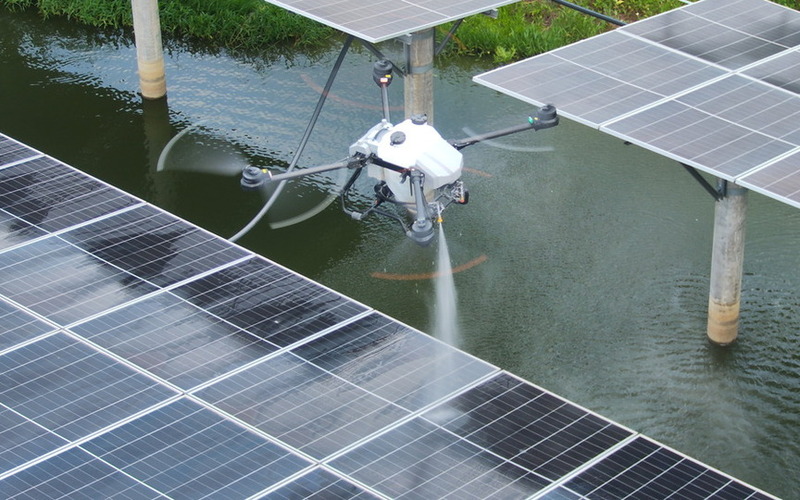
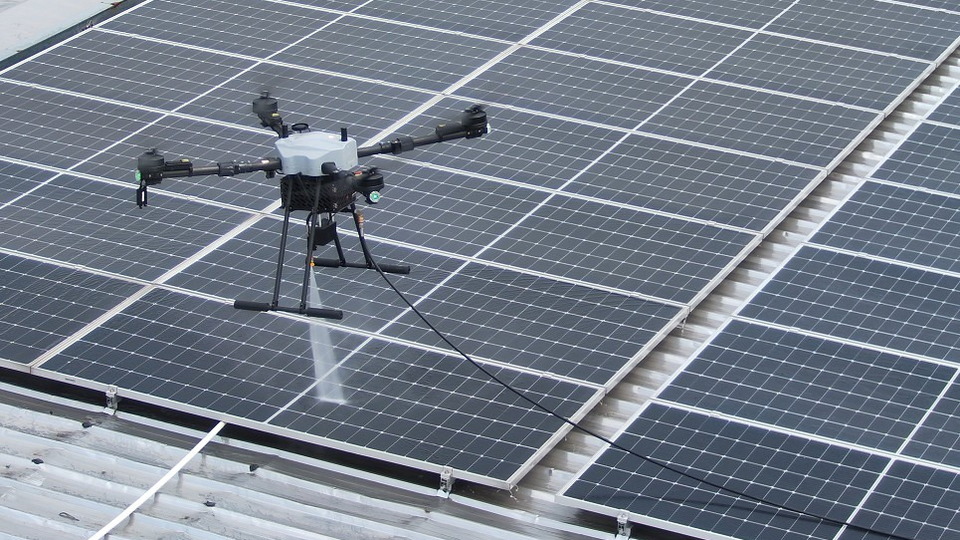
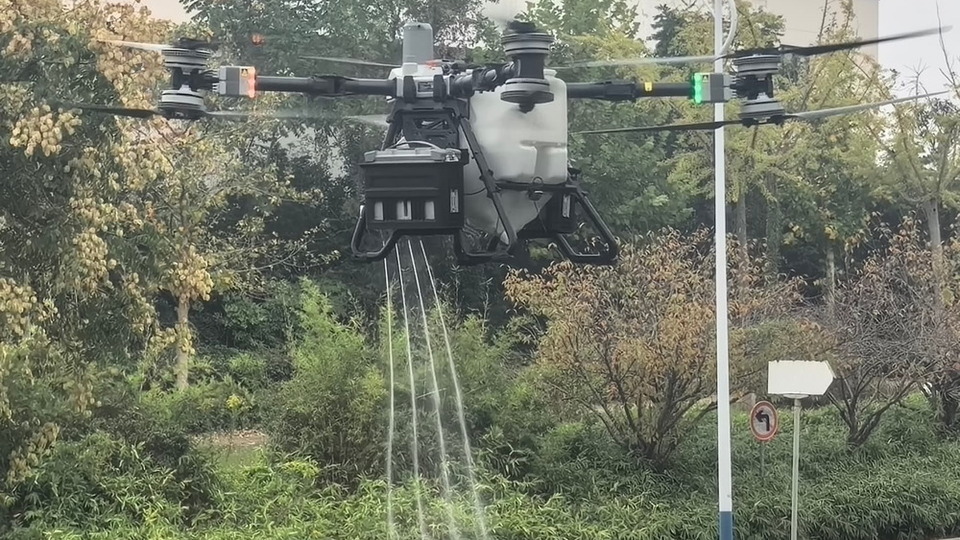
This is the part people picture. The drone holds a fixed line above or beside the array and sweeps the spray across the glass at low pressure, panel by panel, row by row. The operator keeps a constant standoff distance; the module does the fine work.
5. Row transition
Between rows, the drone shifts one line over without leaving spray mode, keeping the rhythm steady. Well-planned transitions are where drone cleaning quietly beats manual work: no ladders moved, no harnesses re-clipped, no panels stepped on between rows.
6. Review and photos
After each section, the crew photographs the cleaned area — before/after records that plant owners increasingly ask for in O&M contracts. Anything the camera flags (heavy soiling spots, chipped glass, loose connectors) is reported rather than silently flown past.
7. Pack and move to the next section
The whole system — payload, tank, hose, ground unit — packs down and moves. For a mid-size plant, the same kit cleans several sections in a day, which is exactly the scale where this method pays off.
The Equipment List Behind the Process
The kit is short, which is one reason the method scales:
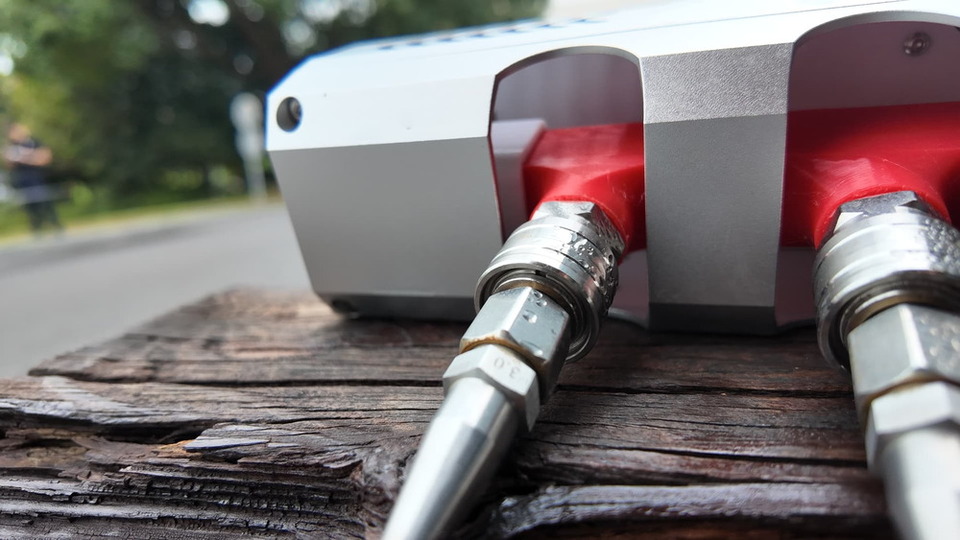
- A cleaning payload: a spray module mounted under the drone, fed from the on-board water tank — on our side that's the FC100 solar panel cleaning payload
- Water supply: a ground tank with a pump and feed line
- A suitable flight platform: we work with DJI-compatible industrial platforms
- A ground station: the remote setup one operator and one assistant run the whole shift from
No scaffolding, no lifts, no rope teams.
Why Low-Pressure Spray Washing Matters
Two reasons, and both are about protecting the asset.
First, glass and cells don't like impact. High-pressure jets can drive water under the frame seals and, over time, contribute to micro-cracks in cells — damage that shows up as hotspots months later. Low-pressure spray with the right nozzle pattern lifts soiling without forcing water where it doesn't belong.
Second, nobody walks on the panels. A large share of glass damage in manual cleaning comes from foot traffic: weight points, dropped tools, scuffed anti-reflective coatings. When the cleaning happens from the air, that entire failure mode disappears.
How the Process Changes by Site Type
Rooftop arrays
Space is the constraint. The survey pays extra attention to parapets, AC units and cable trays, and the water line runs up from a ground source. Flight lines are shorter and transitions more frequent — but nobody carries a ladder across fragile roofing, which is where rooftop cleaning usually hurts.
Ground-mounted plants
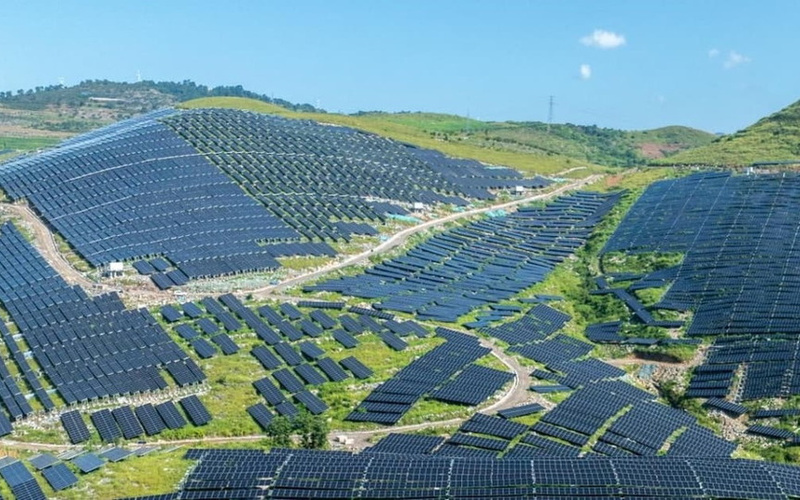
Scale is the advantage. Long uninterrupted rows suit the route-based workflow, and the water supply can follow the cleaning crew along the perimeter. This is the site type where drone cleaning covers the most area per day.
Floating solar
Water is literally below the array — pumping straight from the reservoir largely removes the supply constraint. The trade-offs are humidity, wave motion near shorelines, and anchor layouts that need a careful survey.
The Efficiency Math per MW
The number that decides whether drone cleaning makes sense on a given plant is worker-hours per megawatt per cleaning cycle.
Manual washing on a 1 MW array typically consumes dozens of worker-days once you count harness setup, panel-by-panel brushing, and downtime around peak sun. A drone crew trades most of that labor for flight time and water logistics — the same megawatt is covered by one operator and one assistant over flight days instead of crew weeks.
The other half of the math is how often your climate forces a wash. Soiling research in dry regions keeps finding the same pattern: NREL field data has documented annual energy losses above 20% in parts of the Middle East, and QEERI's five-year measurement program in Qatar recorded daily losses around 0.5%. At those rates, cleaning frequency matters as much as cleaning cost — our earlier drone solar panel cleaning price guide breaks down the cost side line by line.
Where Drone Cleaning Struggles: An Honest Look
Three limits come up on real sites:
- Wind: sustained gusts push the airframe off its line and degrade spray consistency. Above the platform's operating wind limit, the shift stops.
- Midday heat: on hot rooftops the midday window is wasted time — schedules shift to early morning instead.
- Complex obstacles: dense roof sections with many obstructions slow the planning more than the flying. If a roof is mostly obstruction, manual methods may still win that section.
None of these are deal-breakers; they are planning inputs. A realistic supplier will tell you which sections of your site the drone should not take.
Who Builds This Equipment
The cleaning payload described above is built and assembled at our own factory. We supply it as OEM/ODM to distributors and O&M companies in 30+ countries, with 1,000+ units delivered and a 12-month warranty on every unit.
Get a Line-Item Quote
If you're evaluating drone cleaning for a specific plant, send us three things:
- Site type and approximate MW size
- Water access on or near the site
- How often the array needs cleaning in your climate
We'll come back with a line-item quotation — payload, platform compatibility, ground setup and training — with the final numbers confirmed at quotation. Contact our team to start.