Fire Fighting Drone Systems & Payloads
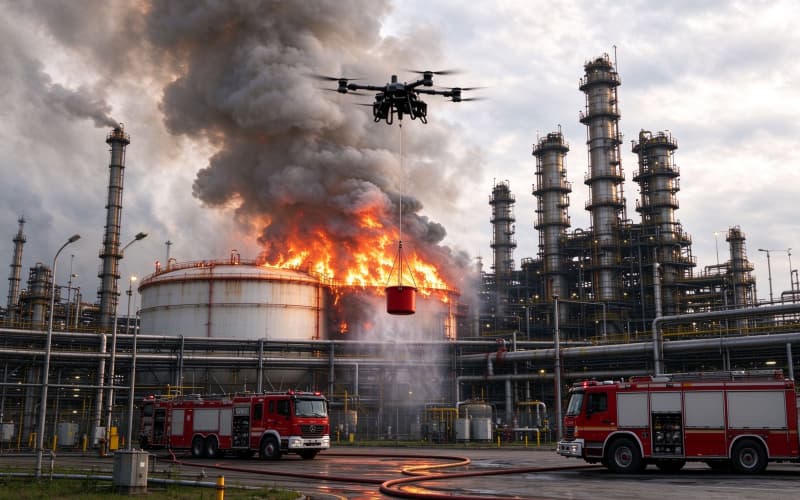
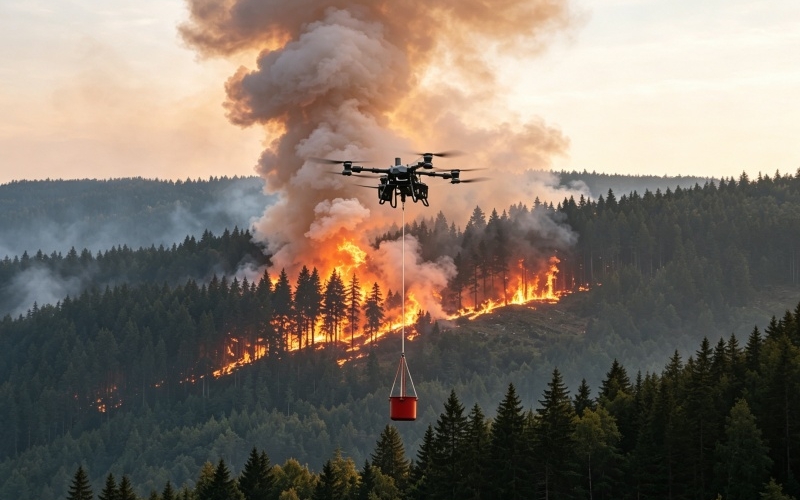
When a fire starts on a steep forest slope, across a peatland, or on the upper floors of a structure, the first twenty minutes decide everything. Fire trucks need roads, helicopters need budgets and airstrips, and ground crews moving uphill through smoke lose time they do not have. This page explains how a fire fighting drone system closes that gap - what it consists of, how an aerial water drop actually works, and what a realistic setup includes.
The Challenge: Fires Where Ground Equipment Cannot Go
Three problems repeat across almost every wildfire and remote-structure response:
Access. Slopes, gullies and vegetation zones that stop vehicles cold are exactly where fires spread fastest.
Visibility. Smoke and darkness hide hotspots; crews often learn about a re-ignition only when it is already established.
Cost. Manned helicopters deliver water but at an hourly cost and logistics footprint that many regional fire services and industrial site operators cannot justify year-round.
A drone-based system attacks all three at once: it flies over blocked terrain, pairs with thermal imaging to see through smoke, and costs a fraction of rotary-wing aviation to own and operate.
Our Solution: Bucket + Platform + Thermal Reconnaissance
WillFly Drone is a drone payload manufacturer and DJI partner since 2016 - we build the working end of the system. A complete aerial firefighting configuration has three parts:
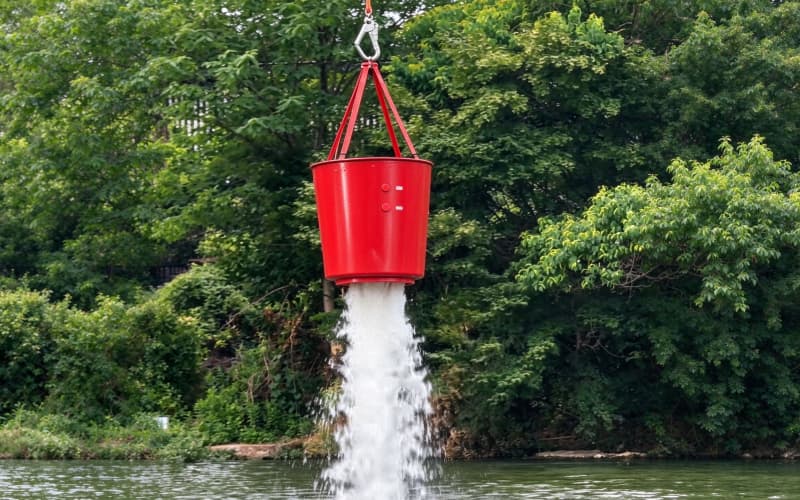
The suppression payload. Our DJI-compatible aerial firefighting water bucket suspends beneath the platform and handles water collection and release.
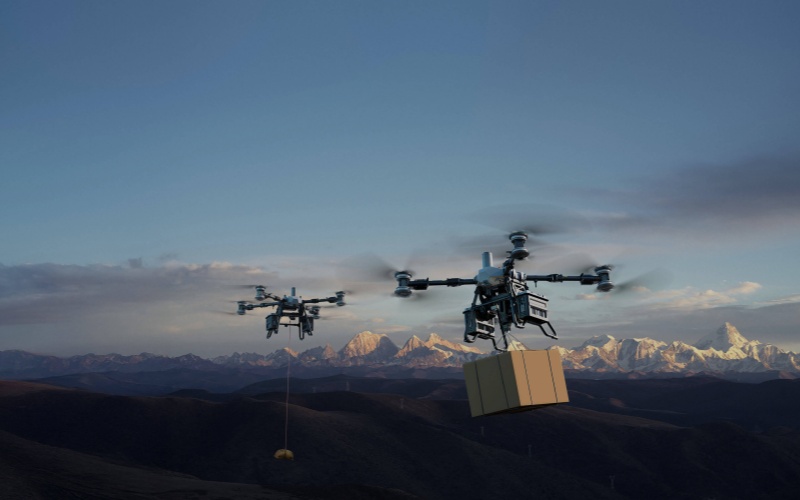
The platform. The bucket integrates with selected DJI platforms - FC30, FC100, FC200 and agricultural drone series - communicating through DJI PSDK, Ethernet, serial port or receiver interfaces, with an independent remote controller also supported.
The eyes. A thermal camera on the same or a second aircraft locates hotspots through smoke and confirms suppression after the drop.
We do not sell the aircraft itself; airframes come through DJI's enterprise channel. What we provide is the payload, the integration know-how and per-project configuration - confirmed at quotation.
How an Aerial Water Drop Works, Step by Step
Reconnaissance. The thermal-equipped aircraft scans the fire line and marks hotspot coordinates through smoke or darkness.
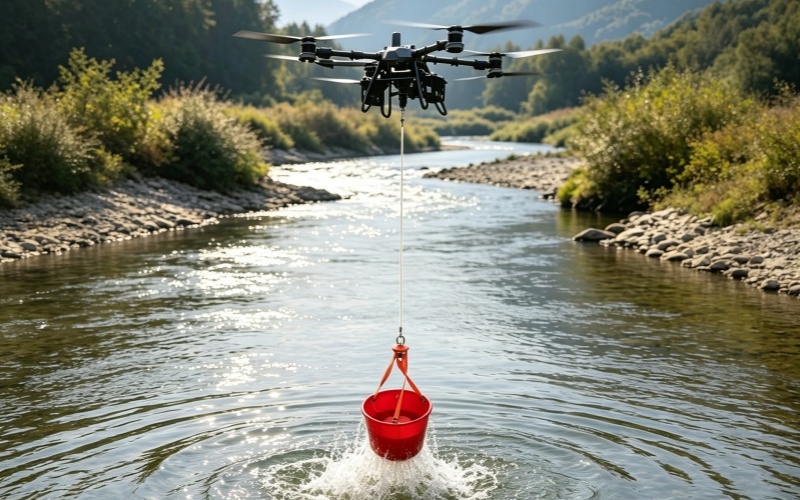
Water collection. The bucket descends to a nearby river, lake or pond and fills directly - from the top or through the bottom inlet - so no ground crew handles water supply.
Transit and aim. The loaded aircraft flies to the marked coordinates while the operator monitors load and position in real time.
Controlled release. The wireless valve opens with 0-100% linear adjustment, so the pilot meters the drop - a full dump for a flare-up, a metered line for a fire break.
Rotation. The system automatically identifies and connects up to five buckets, so a returning aircraft swaps loads in seconds and keeps cycles continuous; a second pass with thermal imaging confirms the hotspot is out.
What the Hardware Actually Delivers
Numbers below come from our bucket's published specification:
Six capacity options - 40L, 60L, 100L, 160L, 180L, 200L - matched to the platform's payload capability.
Valve response within 0.6 seconds and maximum water flow of 50 L/s for rapid, targeted release.
Three media types - water, fluoroprotein foam and water-based extinguishing agents - for different fire classes.
Field-ready construction - IP68 protection, aviation-grade aluminum alloy body with fire-resistant surface treatment, independent built-in battery and OTA firmware updates.
For context on scale: we ship across 30+ countries with more than 1,000 units delivered, and every unit carries a 12-month warranty with MOQ of one set.
Where the System Earns Its Keep
Four operating patterns cover most deployments - each links to a detailed breakdown:
Wildfire support in difficult terrain - slopes and ridges where vehicles stall; see four firefighting drone use cases in detail.
Detection before suppression - how thermal imaging finds hotspots and night fires is covered in thermal drone firefighting applications.
The mechanics of the drop - fill, release and valve behavior are explained in how a firefighting water bucket works.
Choosing the configuration - comparing buckets, thermal cameras and platforms is laid out in our firefighting payload selection guide.
Frequently Asked Questions
How much water can a firefighting drone carry per trip?
With our bucket, 40 to 200 liters depending on the capacity option selected and the platform's payload rating. Multi-bucket rotation keeps the cycle running so total throughput per hour matters more than a single load.
Which drones can carry the bucket?
Selected DJI platforms including FC30, FC100, FC200 and agricultural drone series, integrating through DJI PSDK, Ethernet, serial port or receiver interfaces. Tell us your platform and we confirm the configuration at quotation.
Can the system operate at night?
Yes - water release is remotely controlled and thermal imaging supports operation in darkness and smoke, which is precisely when early re-ignitions are normally missed.
What does a complete setup cost?
It depends on bucket capacity, platform and communication options, so we quote per project. MOQ is one set, lead time 15-30 days after order confirmation, warranty 12 months.
Get a Site-Specific Proposal
Terrain, water sources and fire load differ on every site, so a configuration that fits one operation rarely fits another. Send us your platform model, target scenario and typical fire size through the contact page, and our engineers will return a spec sheet and quotation for a system sized to your operation.