How to Choose a Firefighting Drone Payload
More and more fire and rescue teams are adding drones to their fire fighting equipment, and the payload market has grown along with them. But a firefighting drone payload that suits a forestry bureau running heavy-lift platforms will be the wrong choice for a city brigade with mid-size drones. The six factors below are the ones that actually decide whether a system fits your operation.
1. Start With Your Drone Platform
Before comparing buckets, be clear about what your platform can carry. Water weighs about 1 kg per litre, so a full 200L bucket adds roughly 200 kg of suspended load. That load has to sit inside your drone's rated capacity with margin to spare; take-off weight, battery configuration and expected wind conditions all eat into the margin.
If your team flies compatible DJI platforms, check that the payload attaches through a supported interface. Our system works with DJI PSDK and other communication interfaces, which keeps integration straightforward on platforms that support them.
2. Match Capacity to Mission Type
The bucket is available from 40L to 200L, and the right size follows from your typical mission:
| Mission profile | Suggested capacity | Why |
|---|---|---|
| Initial attack, small fires, urban patrol | 40-60L | Lighter load, faster shuttle cycles, easier handling |
| General suppression, vegetation patrol | 80-120L | Balanced drop size and shuttle frequency |
| Established fire lines, heavy-lift platforms | 150-200L | Maximum drop per sortie where every pass counts |
When in doubt, choose the capacity your platform can lift comfortably on a hot day at altitude, not the biggest number on the datasheet.
3. Flow Rate and Valve Response
Two numbers define release performance. The first is maximum water flow: our system delivers up to 50 L/s, which decides how fast the bucket can empty during a drop pass. The second is valve response time. At ≤0.6 s the valve follows the operator's command almost immediately, and over a target whose release window lasts only seconds, that difference is easy to feel.
Control granularity matters just as much. A 0-100% linear valve opening lets the same bucket do a light wetting pass over personnel positions and then a concentrated drop on a hot spot, with no hardware changes in between.
4. Water Collection Method
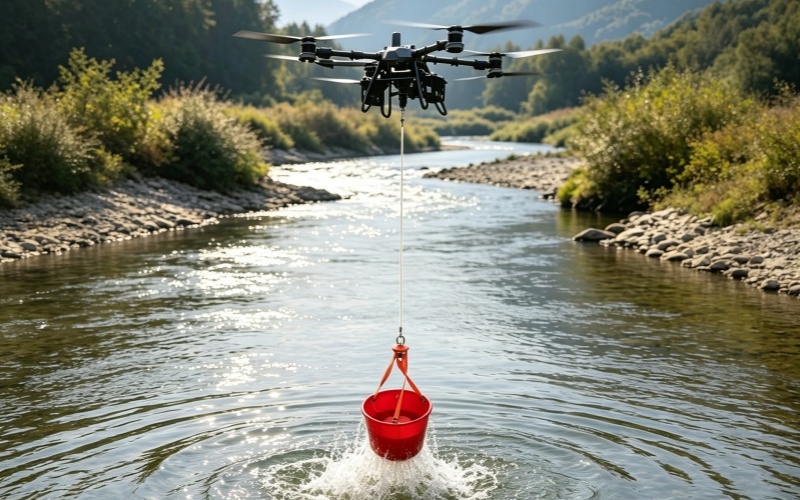
Check how the bucket refills. Support for both top and bottom water collection gives operators options: top filling works across open water surfaces, bottom filling speeds things up in deeper water. The more refill options the system tolerates, the shorter your shuttle loop. And shuttle speed, not bucket size, often decides how much water you actually deliver per hour.
5. Agent Compatibility
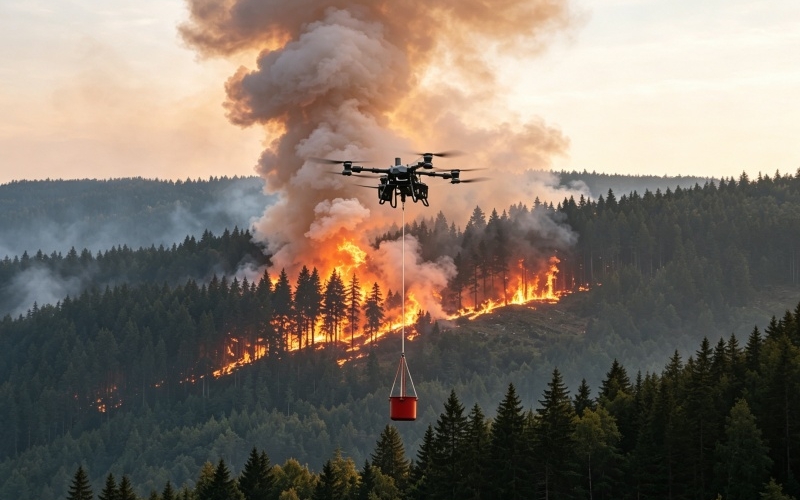
If your scenarios include vegetation fires or reignition risk, make sure the bucket handles more than plain water. Ours takes water, fluoroprotein foam and water-based fire extinguishing agents. Foam and agents improve knockdown on certain fuel types and help hold the line between drops.
6. Continuous Operations: Multi-Bucket Rotation
For anything beyond first response, one bucket becomes the bottleneck. The system supports automatic identification and connection of up to five buckets: while one is being refilled on the ground, the next is already airborne. That rotation keeps water moving without waiting, and several platforms can share one bucket set during larger operations.
7. Pre-Purchase Checklist
Rated payload capacity of your platform confirmed against the filled bucket weight
Capacity (40-200L) matched to mission profile
Flow rate and valve response verified (50 L/s, ≤0.6 s on our system)
0-100% linear valve control, wireless with independent remote support
Top and bottom water collection both supported
Agent compatibility if foam or extinguishing agents are planned
Multi-bucket rotation if continuous operations are expected
Communication interface compatible (DJI PSDK supported)
For a detailed look at how the system behaves in the field, read how drone firefighting water buckets work, or go straight to the aerial firefighting water bucket product page for full specifications.
WillFly Drone supplies fire fighting payloads to fire and rescue teams, forestry departments and UAV distributors, with OEM/ODM support for distributor programmes. Contact us with your platform model and mission profile. Our engineers will confirm compatibility and reply within one working day.