Drone Solar Panel Cleaning Price Guide
Search “solar panel cleaning drone price” and you will rarely find a straight number — and that is not an accident. A cleaning drone is not one product. It is a system: a cleaning payload, a flying platform that carries it, and the ground setup that keeps both running all season. A quote that collapses everything into a single figure hides exactly the parts that decide whether the purchase pays off.
This guide breaks the price into three blocks you can compare line by line, shows how the math works at 1 MW scale, and lists the situations where buying one simply does not make sense.
What the Price Actually Covers
A complete aerial cleaning package has three cost blocks. Comparing vendors becomes much easier when each block is quoted separately:
| Cost block | What is inside | What to check |
|---|---|---|
| Cleaning payload | Spray module, water tank, pump and hose lines, mounting kit | Pressure staging, tank capacity, hose reach, mounting interface |
| Flying platform | The industrial drone that carries the payload | Payload weight class and flight time under load — skip this block if you already operate a compatible platform |
| Ground support | Operator training, spare parts, logistics, water supply plan | Who refills water, who repairs what, how fast spares arrive |
A payload-only quote is legitimate — as long as you know the other two blocks are on you.
Cost Block 1: The Cleaning Payload
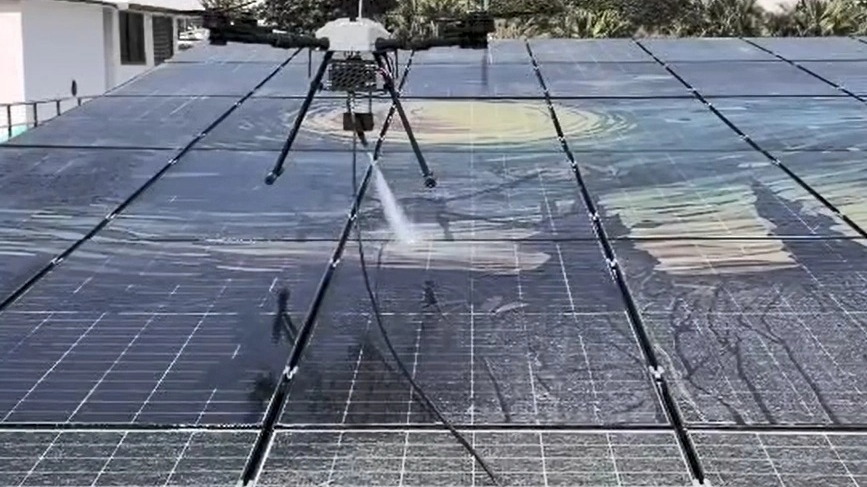
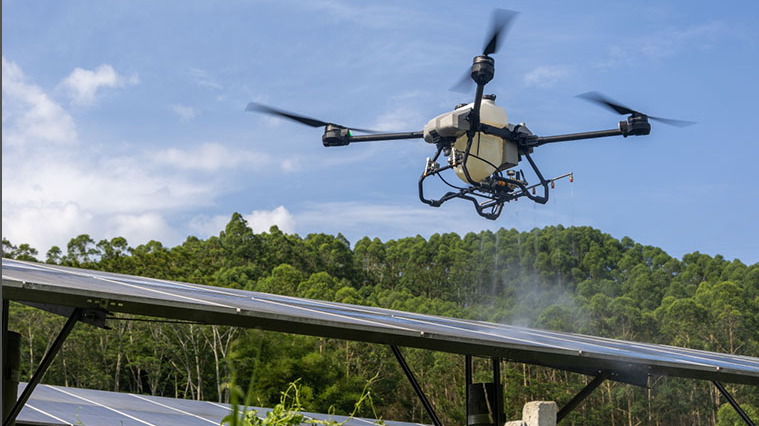
The payload does the actual work. In our FC100-class solar cleaning module, the spray unit sits under the aircraft body and feeds low-pressure water across the glass while the drone advances row by row, with an onboard water tank and hose lines completing the loop.
Four design choices drive most of the price difference between payloads:
Pressure staging — enough force to lift dust and bird droppings, low enough not to stress seals or cells
Tank capacity — how long the drone can work between refills
Hose reach — whether ground supply can feed the far corners of the site
Mounting interface — how the module attaches to the platform, and whether one aircraft can switch between cleaning and other payload work
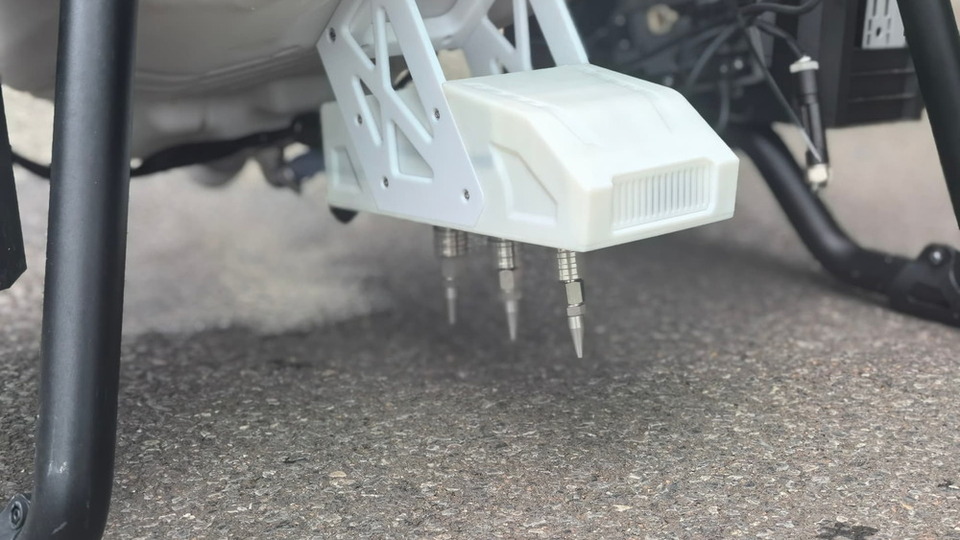
The module itself is described in detail on our FC100 solar panel cleaning payload page.
Cost Block 2: The Flying Platform
If your team already flies a compatible industrial platform, the incremental cost here is close to zero — the cleaning module mounts on and you are in business. This is the most common setup we quote: the payload as an add-on to an aircraft the customer already owns.
If you are starting from zero, the platform becomes the largest single item in the package. Compatibility matters more than headline specs: payload weight class, mounting interface and flight time under load decide whether the pairing actually works on your site.
Cost Block 3: Ground Support and Setup
This is the block buyers skip and later regret. It covers four things:
Operator training — for the crew that will run daily cleaning shifts, not just the demo day
Spare parts — nozzles, seals and hose fittings that wear in normal service
Logistics — freight, customs paperwork and delivery scope to your country
Water supply — a tanker on site, a fill point at the plant, or a nearby water source with basic filtration
Water is the one that changes daily operating cost the most. A site that can feed the system continuously runs far cheaper per wash than one that depends on trucked water.
The 1 MW Perspective: Frequency × Cost per Wash
The number that actually matters is not the price of the package. It is the annual cost of keeping the plant clean — cleaning frequency multiplied by cost per wash.
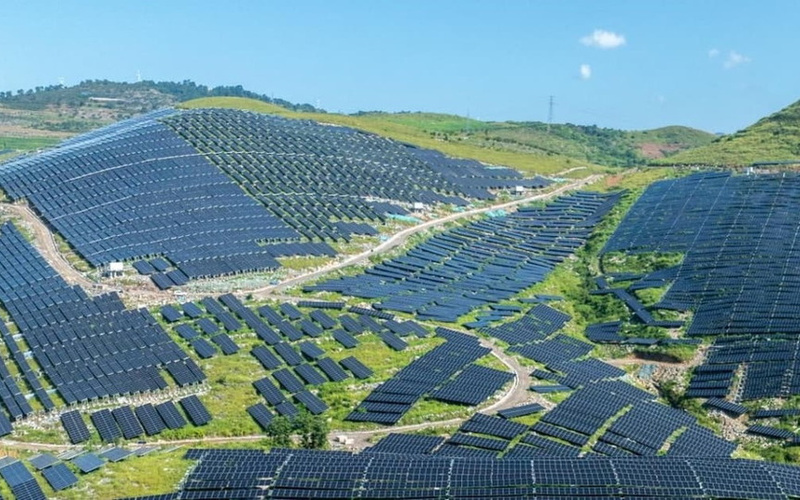
Frequency is set by your climate, and the field data is not subtle. A five-year study in Qatar measured soiling losses of roughly 0.5% per day on average, and NREL puts annual soiling losses above 20% in parts of the Middle East. In dry, inland regions, monthly losses above 1% are common. For a full breakdown by climate type, see our guide on how often solar panels should be cleaned.
At 1 MW, a soiling loss of even a few percent compounds quickly against plant revenue. That is why the purchase decision should start from your measured or estimated loss rate — not from a payload price list.
Five Variables That Move Your Quote
When you ask for a quote, these five inputs decide the number you get back:
| Variable | Why it matters |
|---|---|
| Plant size (MW) | Determines water volume, tank refills and crew days per cycle |
| Site type | Rooftop, ground-mount and floating plants each need different logistics |
| Water source | On-site supply cuts cost per wash; trucked water adds cost to every cycle |
| Cleaning frequency | High-frequency sites justify larger tanks and faster resupply |
| Delivery time | Freight and production lead time shape the final landed cost |
When a Cleaning Drone Does Not Pay Off
An honest guide has to include the cases where the right answer is “don’t buy”:
You run a small rooftop array and already have an in-house crew with idle capacity — their marginal cost is close to zero
Your site gets regular, heavy rain that does most of the cleaning for free
You have a scaffolding or rope-access team under long-term contract for other work
The array is so small that mobilizing any flying system dominates the cost per wash
For large ground-mount plants in dusty regions, the math usually flips the other way — that is exactly where drone cleaning earns its keep.
Get a Line-Item Quote
Send us three things — approximate plant size in MW, site type (rooftop, ground-mount or floating), and how water is sourced on site — and we will return a line-item quote covering payload, platform compatibility and ground support, with final figures confirmed at quotation.
Start with our solar panel cleaning solutions page, or contact our team directly with those three inputs.