Welding Seam Inspection with Robot Dogs
In a steel fabrication shop, a welder finishes a run of butt joints on a box girder, knocks off the slag, and moves on. Those seams will be looked at later, if the job can spare the people. On most contracts full inspection of every joint is a schedule nobody can afford, so the quality plan asks for a percentage and the rest of the welds are trusted.
That gap between “inspected” and “built” is where a quadruped robot earns its place. It is not an inspector and it does not replace ultrasonic testing. It is a carrier that walks the same route every shift, stops at the same joint, and brings back a picture good enough for a person to judge.
Why Weld Seams Get Missed
Getting a person to a weld is usually harder than inspecting it. On a bridge that means a platform slung under the deck or a rope team waiting for the wind to drop. In a turbine tower it means confined space entry with a gas meter and a standby man outside. In a shop it means waiting until the part sits at a workable height, or climbing over it in a way nobody enjoys.
Each of those is doable. The problem is that each one is slow and expensive enough that the job gets sampled instead of covered. Sampling has a predictable failure mode: the joint nobody reached is the one that starts a crack three years later, when the warranty conversation has already moved on.
What the Robot Actually Carries to a Seam
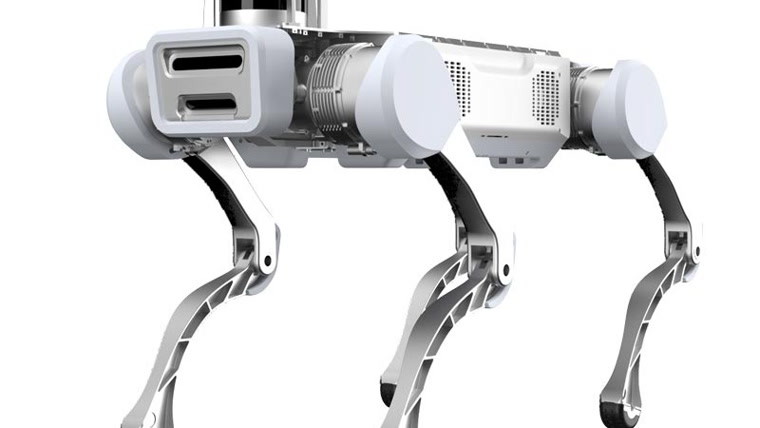
The four-legged platform is only the mule. What decides whether the inspection is worth anything is what sits on its back, and how steadily it holds position while the image is taken.
A camera head that can stand off
A zoom lens lets the robot photograph a seam from a metre or two away instead of pressing up against it. That standoff matters. It keeps the robot out of the weld's heat and out of the welder's way, and it gives the frame a consistent angle, which is the difference between an image you can compare and an image you can only look at.
A thermal imager
Thermal does not measure weld quality and should not be sold as if it does. What it shows is where heat sits and how it leaves. A patch that stays hot long after its neighbours have cooled, or a heat-affected zone that runs wide on one side of a joint, is a reason to look closer. It is a screening tool, not a verdict.
Light, gas and a fixed sitting position
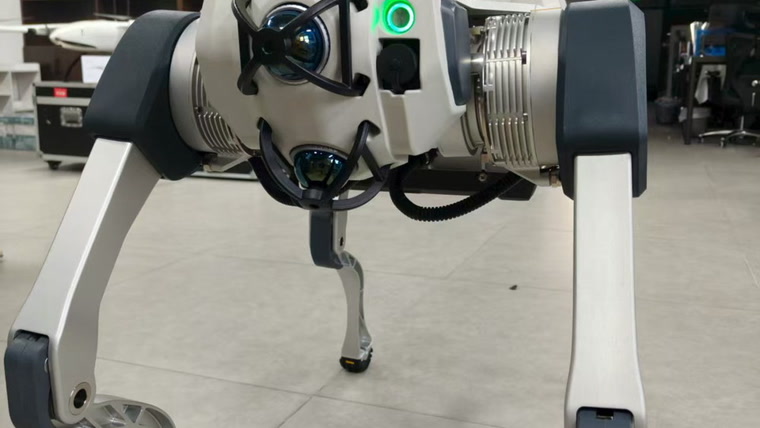
Shop lighting is often worse than it looks in photographs, and the inside of a box girder has none at all, so a light on the payload is not a luxury. For confined spaces, an oxygen and combustible gas reading before anyone enters is standard practice, and a robot can take that reading first. The least glamorous part — returning to the same spot at the same distance — is the part that makes repeat visits useful.
The Inspection Walk, Step by Step
Step 1: Map what was actually built
The first pass is slow and has no inspection goal. It builds a map and marks joint positions. Drawings help, but on most sites the structure as built has drifted from the structure as drawn, and the robot has to be taught the difference.
Step 2: Fix the standoff
Every joint gets photographed from the same distance and angle. This sounds like a detail and it is the entire value of the method: two frames of one seam taken six months apart from the same position can be placed side by side. Two handheld photos of the same seam usually cannot.
Step 3: Capture visible and thermal on the same stop
One stop, both sensors, one time stamp. The visible frame shows the bead; the thermal frame shows the heat that is still in it. Splitting these into two visits is how records end up describing two different days.
Step 4: Flag, do not judge
The platform marks frames where something looks off: a bead that narrows without explanation, a patch that stays warm longer than its neighbours, a joint the robot could not get a clean angle on. A flagged frame is a question handed to an inspector, not an answer that replaces one.
Step 5: Leave a record that survives the project
Report per joint: image pair, position, time, flag status. It is filed whether or not anything was found. A percentage inspection is only defensible if the percentage can be shown, and this is what shows it.
What It Can Flag, and What It Cannot
Being clear about the second column is what makes the first one credible.
| Visible or thermal signs it can flag | It cannot do this | Who owns that decision |
|---|---|---|
| Bead profile that varies along a run | Detect lack of fusion or slag inclusion | Ultrasonic or radiographic technician |
| Visible porosity, undercut, heavy spatter | Sign off a pressure-retaining part | Certified welding inspector |
| Surface-breaking cracks and weld-toe corrosion | Measure dimensional tolerance | Metrology or a 3D scan |
| Misalignment between members | Judge weld quality under live arc | Nobody — the arc is not a camera subject |
| Uneven cooling and hot spots after welding | Replace magnetic particle or dye penetrant | NDT technician on site |
The robot's job is to make sure that when the inspector does arrive, the record is complete and the anomalies are already listed. That is a smaller claim than “automated weld inspection”, and it is the one that holds up in a quality meeting.
Where This Fits on a Real Job
It suits structures a machine can walk up to and around: fabrication yards, bridge box girders and bearings, turbine towers and flanges, crane runway beams, shipyard blocks, tank shells, transmission towers, and the cable trays and steelwork inside a plant. Floors, stairs and catwalks are its home ground, and so is the boring middle of a long repetitive run where a person's attention fades after the fortieth joint.
It is a poor fit for the inside of a small pipe, where a crawler belongs; for a weld finished two minutes ago, where radiant heat ruins the image and no one should be that close; and for a joint that needs a dimensional report rather than a photograph. Sending a robot at those problems wastes a day and produces a file nobody trusts.
Robot Dog, Crawler or Rope Access
These are not competitors fighting for the same job. They fail in different places, which is why a sensible inspection plan uses more than one.
| Method | Setup time | Reaches | Repeatability | Weak point |
|---|---|---|---|---|
| Rope access | Half a day | High and awkward faces | Depends on the technician | Weather, and a person at height |
| Scaffolding | Days | Almost anything | Good | Cost and schedule |
| Crawler | An hour | Bores, tanks, ducts | Good | Cannot climb or step over |
| Quadruped with payload | Minutes | Floors, stairs, catwalks, cable trays | Same position every visit | Not for pipes or live arc |
The reason to add the fourth row is not that it is cheaper than the other three on day one. It is that the same machine can come back next month, and the month after, without a new mobilisation each time.
What a Working Setup Includes
A robot, a camera and thermal payload on a stabilised head, a control and inspection platform that files frames against joint IDs, spare batteries, and one person trained to run the route and read what comes back. The platform matters more than the robot. A robot without a record is a toy with legs.
We supply the payload and the setup around it, and we stay platform-agnostic on the robot itself — the robot dog payloads we ship are built to mount on a quadruped you already have or one we source with you. For teams comparing this against their current method, the wider ground robotics and inspection setup covers patrol, thermal survey and gas detection on the same platform, so the machine is not idle between weld campaigns.
Next Step
If you want a real answer rather than a demo, tell us three things: what the structure is, where the welds sit, and what percentage your quality plan currently checks. Those three decide whether a walking platform makes sense or whether you need a crawler, a rope team or nothing new at all.
Send the details through our contact page and we will reply with a route, a payload list and the honest limits for your case.
One question worth sitting with: how many of your weld seams does anyone actually look at today — and do you know which ones were skipped?