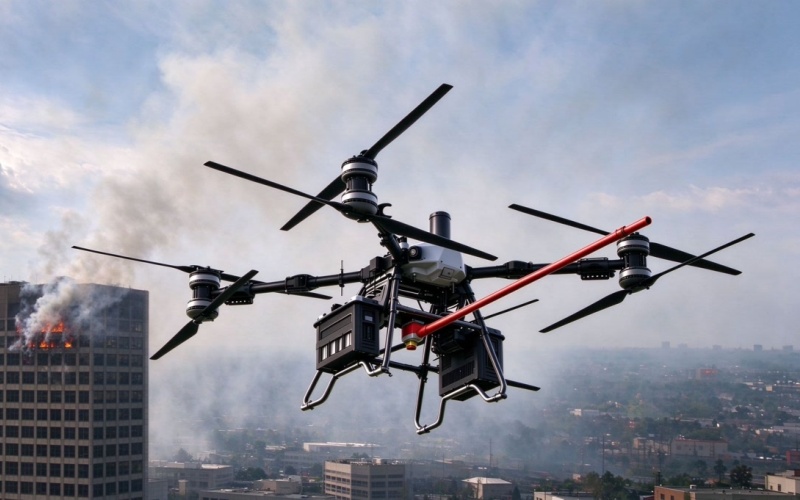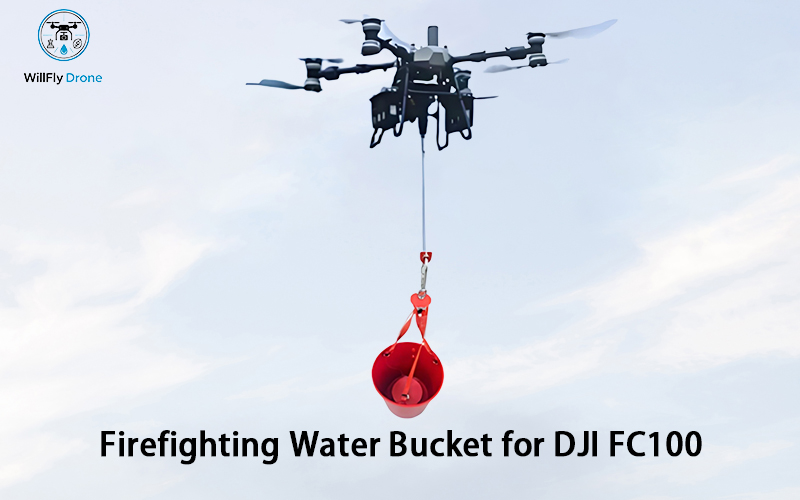
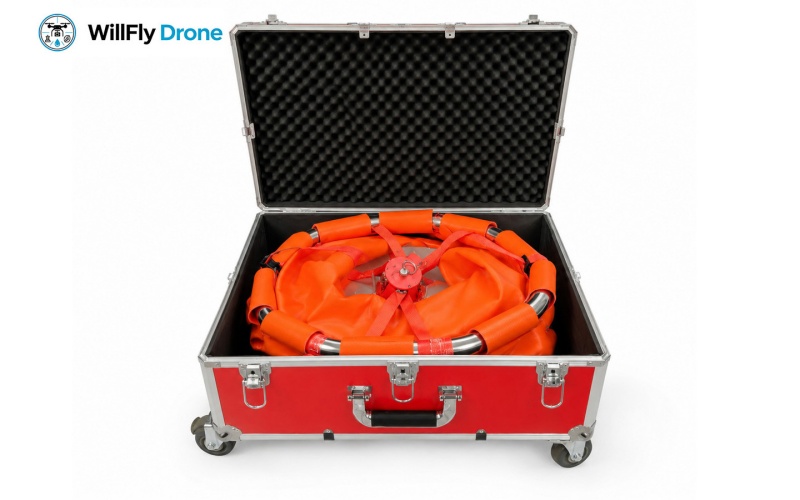
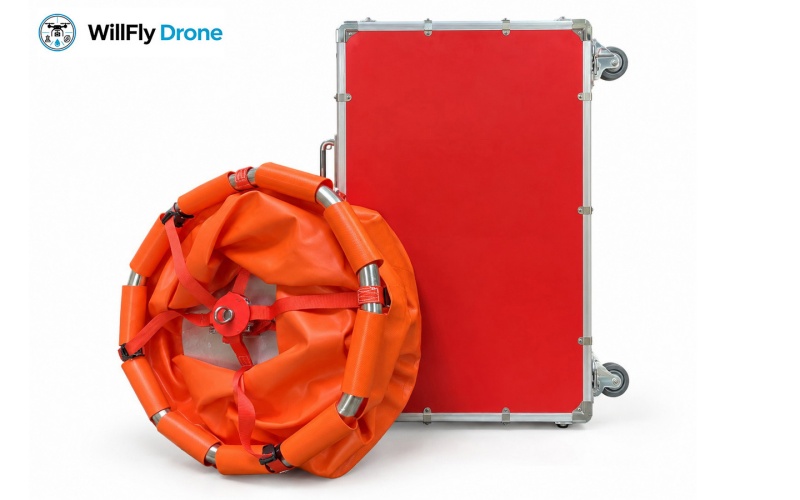
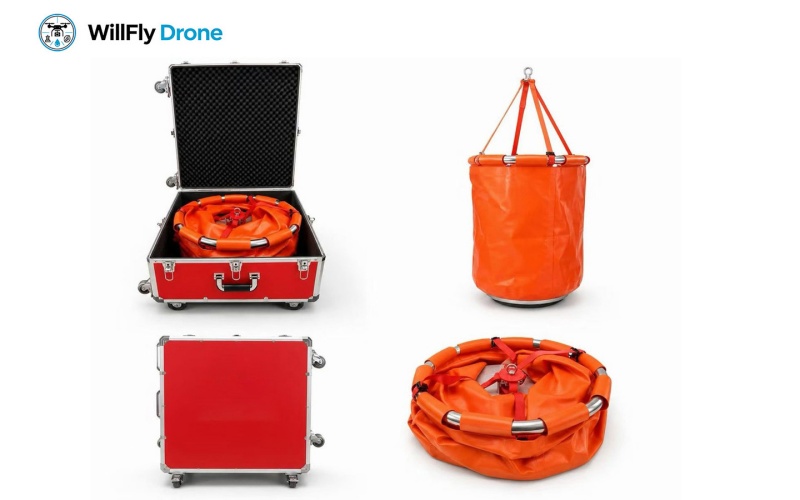
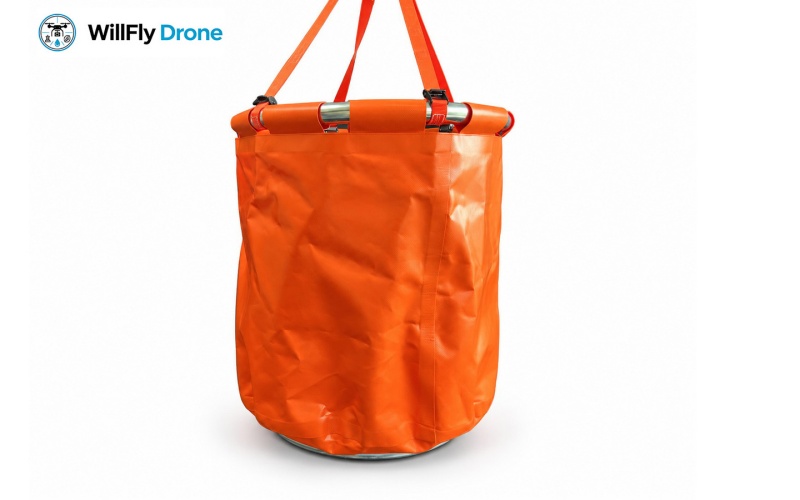
Every wildfire call starts the same way. The fire is still small, and the water is far. This soft-shell bucket is built for that gap: 100 to 200 litres per pass, filled straight from a pond, canal or reservoir, and folded into a flight case small enough to ride in the back of a pickup.
A grass fire on a hillside above a village. The nearest hydrant is down in the village. The nearest pond is at the bottom of the valley, with a few hundred metres of steep track between it and the flames. A tanker can reach the lower road if the surface holds. By the time hoses are laid and pressure is up, a two-metre fire front can be twenty.
This is where most aerial firefighting money is spent badly. A helicopter is the right tool and the wrong cost for a fire that is still the size of a room, and the call takes time you do not have. A drone is already on the truck. What it does not have is water.
That is the problem this bucket solves, and everything below is about how.
The water source is a pond, not a hydrant. Pumps, suction lines and hose runs take time to set up on ground you have not walked yet.
Rigid buckets eat the truck. A hard-body aluminium bucket does not stack, does not fold, and costs real money to air-freight when you deploy across a border.
The aircraft keeps landing to refill. Every return to the water point is a pass not made on the fire.
The valve is on or off. One hotspot gets the whole load, and the ground team watches the rest run downhill.
100 to 200 litres in one pass, released where you aim it. Three capacities, one control logic, no airframe modification.
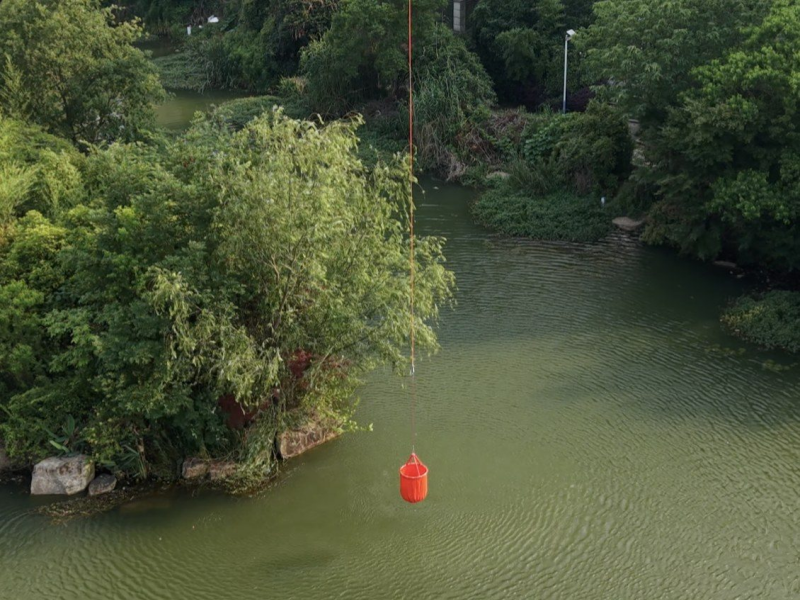
Bottom fill from open water. Lower the bucket into the pond, fill, climb. No pump, no hose, no ground crew assigned to water supply.
Valve opens 0 to 100% linearly. A hotspot gets twenty litres instead of the whole load, with response under 0.6 seconds at any opening.
Five buckets, one controller. The aircraft rotates between pre-filled buckets while the ground team refills, so it stays over the fire instead of over the water.
Folds under 20 cm. A complete set with slings and control box travels in one aluminium flight case — air-freightable, and it fits a pickup bed alongside the rest of the kit.
The bucket connects to the FC100 and FC200 through PSDK or the sky-end control box, so valve opening is commanded from the same controller you already fly with. No separate app, no second operator.
DJI agricultural platforms and third-party airframes run the bucket on the dedicated remote supplied in the case, over PSDK, Ethernet, serial port or receiver. Mounting is modular: the bucket hangs from a sling and lifting ring, and nothing on the airframe is drilled or modified.
It is a payload, not an aircraft. Beyond the added weight, the FC100 and FC200 fly exactly as they did before, and the bucket can be swapped out for a spray or cleaning payload between missions.
Capacities are matched to the platform, not the other way round — tell us the aircraft and the drop size you need and we will confirm the model.
| Item | 100 L | 160 L | 200 L |
|---|---|---|---|
| Model | 100 L | 160 L | 200 L |
| Maximum capacity | 100 L | 160 L | 200 L |
| Bucket weight | ≤10 kg | ≤12 kg | ≤12 kg |
| Maximum discharge | 45 L/s | 50 L/s | 50 L/s |
| Diameter | 55 cm | 65 cm | 65 cm |
| Folded height | Under 20 cm on all three | ||
| Sling length | 10 m | ||
| Water intake | Top fill and bottom fill | ||
| Protection rating | IP68 | ||
| Valve control | Wireless, 0-100% linear opening, response ≤0.6 s | ||
| Extinguishing agents | Water, fluoroprotein foam, water-based agents | ||
| Bucket body | Polyester mesh fabric with double-sided PVC coating, aluminium alloy rim | ||
| Communication | PSDK, Ethernet, serial port, receiver, plus a dedicated remote | ||
| Power and firmware | Built-in battery, wireless OTA firmware updates via app | ||
| Multi-bucket operation | Up to 5 buckets recognised and rotated automatically | ||
| Compatible platforms | DJI FC100, DJI FC200, DJI agricultural drones (dedicated remote), third-party airframes (dedicated remote) | ||
A hard aluminium bucket is the default until you have to move six of them. This one folds flat in seconds, so a complete set with slings and control box travels in a single aluminium flight case, and a spare bucket can ride on the truck without taking cargo space. Same valve, same discharge rate, far less logistics.
If your operation needs a rigid body instead, we also build the rigid aluminium water bucket from 40 to 200 litres. Both use the same control logic, so a fleet can mix them.
Both buckets run the same valve, the same control logic and the same intake options, so this is a logistics decision rather than a performance one.
| Item | Soft-shell (this page) | Rigid aluminium |
|---|---|---|
| Body | Polyester mesh with double-sided PVC coating on an aluminium alloy rim | Aviation-grade aluminium alloy with fire-resistant surface treatment |
| Capacities | 100 L / 160 L / 200 L | 40 to 200 L, including a 40 L version for the DJI FC30 |
| Transport | Folds under 20 cm; a full set with slings and control box fits one flight case | Rigid body; stacks in a rack but does not fold or compress |
| Water intake | Top fill and bottom fill | Top fill and bottom fill |
| Valve | Wireless, 0-100% linear, response ≤0.6 s, up to 50 L/s | Wireless, 0-100% linear, response ≤0.6 s, up to 50 L/s |
| Protection | IP68, built-in battery, OTA firmware updates | IP68, built-in battery, OTA firmware updates |
| Best for | Air-freighted deployments, spare buckets on the truck, pickups and light support vehicles | Station-based teams, daily road access, and light platforms that need the 40 L size |
Rigid wins on capacity range: the standard rigid aluminium firefighting bucket runs from 40 to 200 litres, and the 40 L version also fits the DJI FC30, which the soft-shell does not. Soft-shell wins the moment the kit has to fly, share a pickup bed with the rest of the load, or sit on a shelf as a spare.
Many units carry both: rigid buckets for the daily response vehicle that has a rack and a fixed water point, soft-shell buckets for the mutual-aid kit that gets thrown on a plane or into a helicopter sling load.
The valve opens linearly from 0 to 100%, not just open or closed. You can meter a partial drop on a small hotspot instead of emptying the whole bucket, and the response time stays under 0.6 seconds at any opening. Discharge runs 45 to 50 litres per second depending on the model.
Top fill from a tank, hydrant or fire truck with the bucket on the ground, or bottom fill by lowering the bucket straight into a pond, river or reservoir. The bottom intake is what makes remote water sources usable: no pump, no hose run, the aircraft dips, fills and climbs.
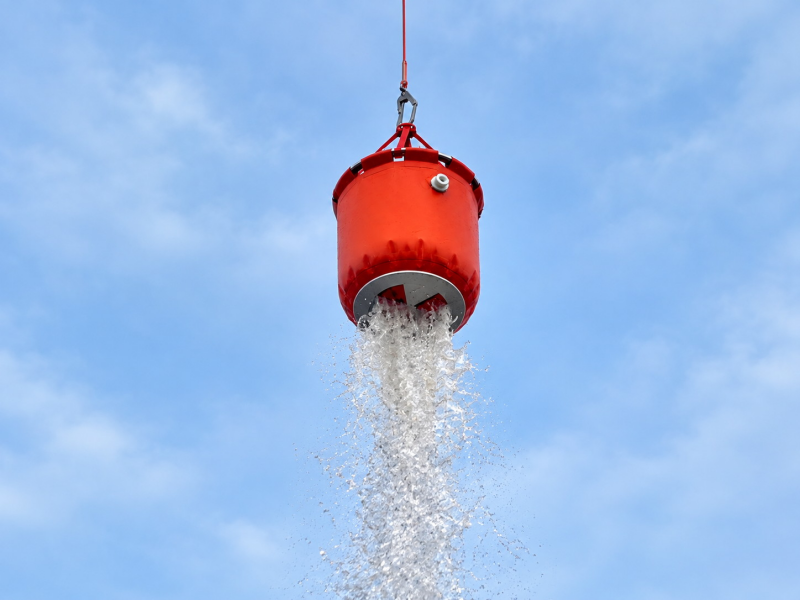
The controller recognises up to five buckets and switches between them automatically. One aircraft can cycle through a stack of pre-filled buckets while the ground team refills, so it spends less time hovering over the water point and more time over the fire. See how drone water buckets work for the drop-cycle basics.
The body is polyester mesh fabric with double-sided PVC coating on an aluminium alloy rim: abrasion resistant, flexible when wet, and it will not dent on landing. The whole unit is IP68 rated, the valve runs on its own built-in battery, and firmware updates go out over the air through the app. Water, fluoroprotein foam and water-based extinguishing agents are all supported.
Bucket ×1, slings ×3, lifting ring ×1, sky-end control box ×1, dual Type-C cable ×1, power adapter ×1, magnetic charging cable ×1, certificate of conformity, warranty card, packing list, aluminium flight case ×1.
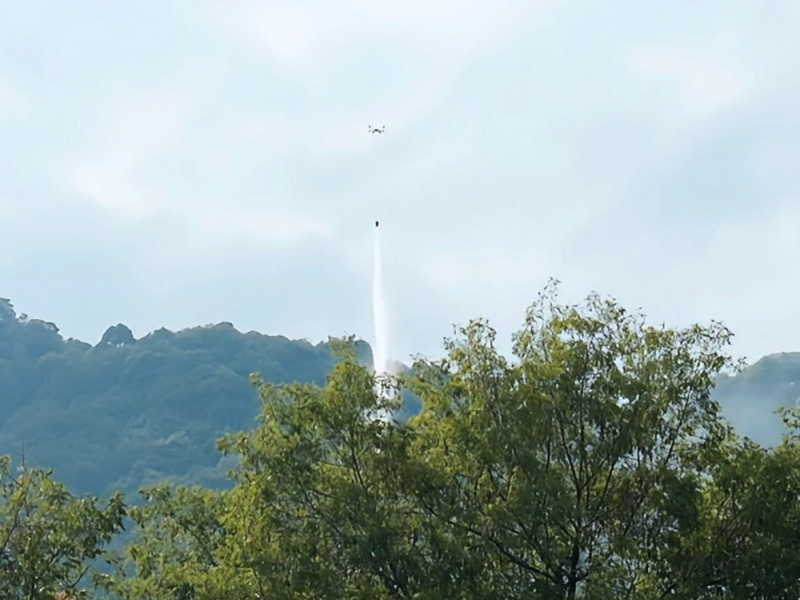
Wildfire and forest edge work where the water source is a pond or stream, not a hydrant
Mountain terrain that trucks cannot reach before the fire does
Structural fires that need a metered drop on one floor or roof section
Teams that fly equipment in rather than drive it, including cross-border deployments
These are the same scenarios covered in our aerial firefighting solutions for DJI platforms.
We build this bucket as an OEM/ODM product. Bucket colour, printed markings and case branding can be customised to your fleet or tender requirement, with a minimum order of 100 units. Capacities are 100 L, 160 L and 200 L; tell us the aircraft and the drop size you need and we will match the model.
WillFly Drone has supplied drone payloads and cleaning systems since 2016, with more than 1,000 units delivered to 30+ countries. Every bucket ships with a 12-month warranty and spare parts support.
Capacity, body weight, diameter and discharge. The 100 L bucket weighs 10 kg or less and is 55 cm across; the 160 L and 200 L are 12 kg or less and 65 cm across. Discharge is 45 L/s on the 100 L and 50 L/s on the two larger models. All three fold to under 20 cm.
Yes, through PSDK or the sky-end control box. Agricultural platforms and third-party drones connect with the dedicated remote supplied in the case.
Water, fluoroprotein foam and water-based extinguishing agents. The PVC-coated body is not affected by foam concentrate.
Up to five, recognised automatically, so the aircraft can rotate between drops while the ground team refills.
Yes. Rinse it, dry it, and check the valve and slings before the next deployment. The fabric does not absorb water and the coating does not need re-treatment after normal use.
Send us your aircraft model and target drop size and we will confirm the right capacity, lead time and freight. Request a quote or message us on WhatsApp at +86 138 128 56149.
We have recommended some of our Related products to you. I hope you will be interested.