

Precision Row Seeding
Adjustable Row Spacing
DJI & XAG Compatible
15–195 kg/ha Seeding Rate
Autonomous Flight Support
The Precision Row Seeding Module is designed for controlled row seeding with agricultural drones.
Unlike conventional centrifugal broadcasting systems, this module places seeds in organized rows with adjustable spacing, helping improve seed distribution and field management.
Seed leaves the module through a reverse-flow drop at the corner of each tube and is launched by the inertia of the metering motor, so it reaches the soil as a continuous ordered line instead of scattering.
The modular system supports quick installation and removal and can be integrated with DJI, XAG, and other compatible agricultural drone platforms.
It is suitable for applications requiring more controlled and precise seeding operations.
Compared with transplanting, there is no nursery to raise and no seedlings to lift, carry and replant. Seed germinates where it lands, so there is no transplant shock to recover from — the crop starts growing in place.
Even spacing is not cosmetic. Broadcast seed lands unevenly, so plants compete for the same light and the stand varies in height and strength. Rows give every plant the same space, and a more even canopy develops more uniform culms — the difference that shows up when wind and rain arrive at grain filling.
It also reaches paddies a ground drill cannot: wet, soft, small or terraced fields. A seeding pass takes 40–60 minutes per hectare, inside a planting window that is often only a few days long.
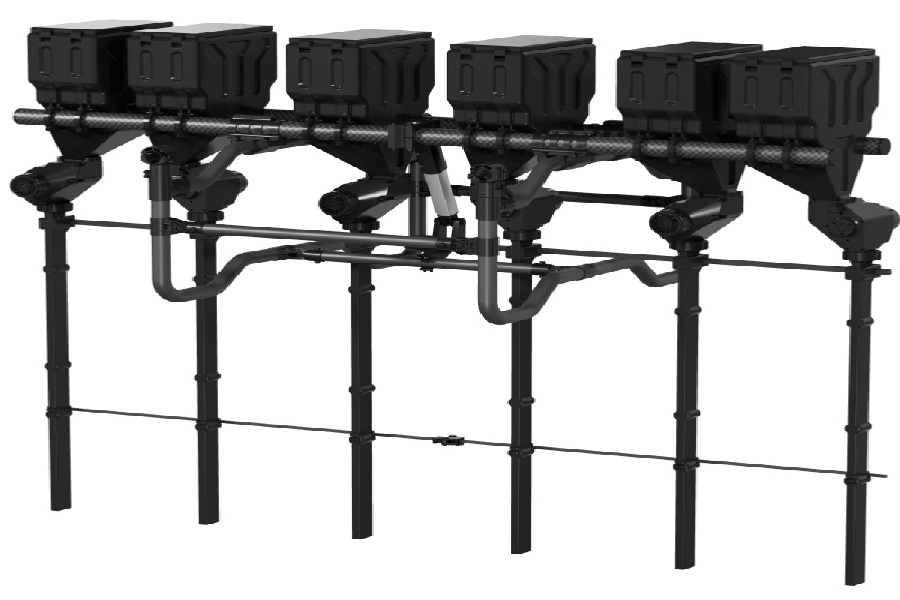
1, Precision Row Seeding: Places seeds in controlled rows instead of conventional centrifugal broadcasting.
2, Adjustable Row Spacing (25–30 cm): Row spacing can be set between 25 cm and 30 cm and adjusted for different crops and planting patterns.
3, Roller Metering, Seed-Safe: Flexible rollers meter seed by volume, so dry, pre-germinated and pelleted seed pass through intact — and every pass delivers the rate you set.
4, Ground-Hugging Seeding (15 cm ± 5 cm): The extended outlets hold the discharge 15 cm ± 5 cm above the ground, so seed lands in the row instead of drifting in the rotor wash.
5, Quick-Release Modular Design: Designed for convenient installation, removal, and integration with compatible agricultural drones.
6, Retractable Seed Tubes: The seeding tubes lift for take-off and landing, so ground clearance and flight safety are not affected.
7, Dry, Pre-Germinated and Pelleted Seed: All three seed types can be sown in ordered rows.
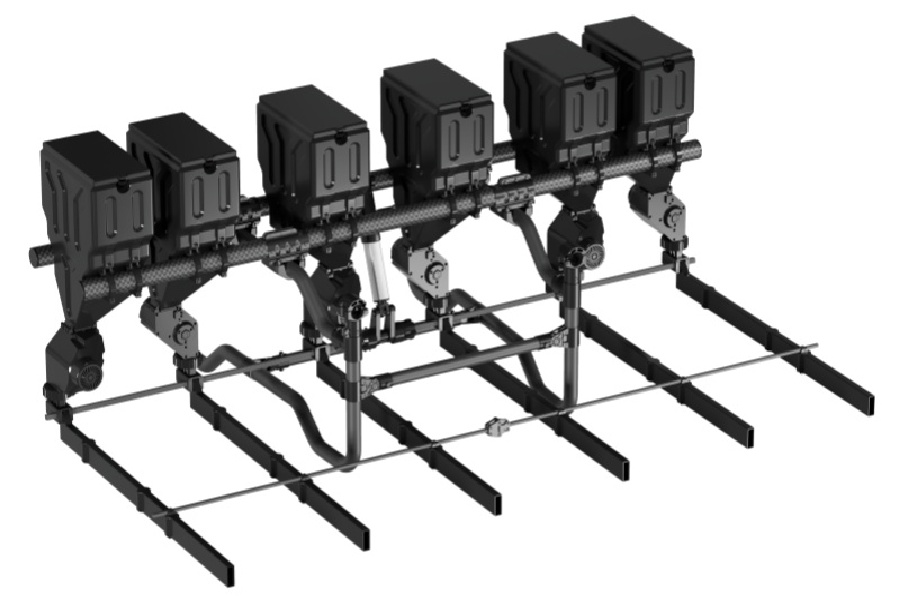
DJI Agras T55, T60, T70P, T70S, T100, T100S · XAG P150, P200
Other compatible agricultural drones
Please contact us with your drone model to confirm compatibility and the module count for your airframe — the number of modules is configured to aircraft size and working width.
| Specification | Details |
| Total Weight | Approx. 17.5 kg |
| Dimensions – Unfolded | 2035 × 1570 × 835 mm |
| Dimensions – Folded | 1950 × 1570 × 705 mm |
| Capacity per Module | 10 L |
| Number of Modules | 4–6 pcs, configured to aircraft size and working width |
| Maximum Seed Capacity | Approx. 50 kg (with 6 modules) |
| Seeding Width | 90–150 cm |
| Row Spacing | 25–30 cm, adjustable |
| Seeding Rate | 15–195 kg/ha (1–13 kg per mu) |
| Coverage per Flight | 0.27–0.67 ha (per battery charge) |
| Recommended Flight Speed | 4–7 m/s |
| Recommended Seeding Height | 15 cm ± 5 cm above the ground |
| Operating Voltage | 50 V |
| Power Supply | Aircraft power supply |
| Control Method | Independent remote control / up to 1 km |
| Seed Detection | Dual detection: tank level + seed tube, with audible alarm |
| Seeding Mode | Autonomous flight + manual seeding |
| Compatible Platforms | DJI Agras T55 / T60 / T70P / T70S / T100 / T100S · XAG P150 / P200 — confirm your model before ordering |
Payload note: a fully loaded set weighs about 67.5 kg (17.5 kg frame and modules + 50 kg seed). Keep that total inside your aircraft's spreading payload. On a DJI Agras T55 (45 kg empty, 104 kg max spreading take-off) the available payload is about 59 kg, so fill to roughly 40 kg rather than 50 kg. On a T60 (62 kg empty, 125 kg max spreading take-off) fill to about 45 kg. On T70-series, T100 and T100S the full 50 kg fits within the published payload.
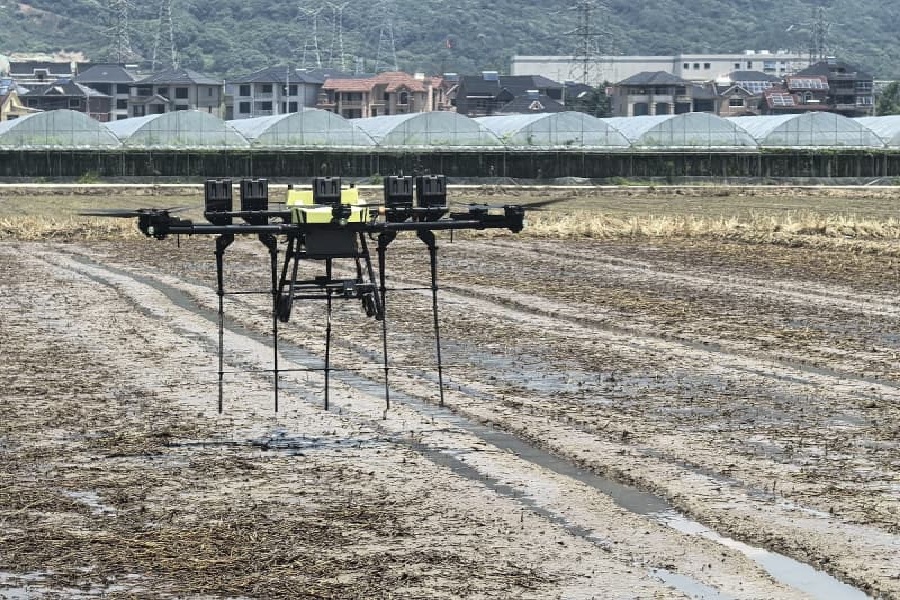
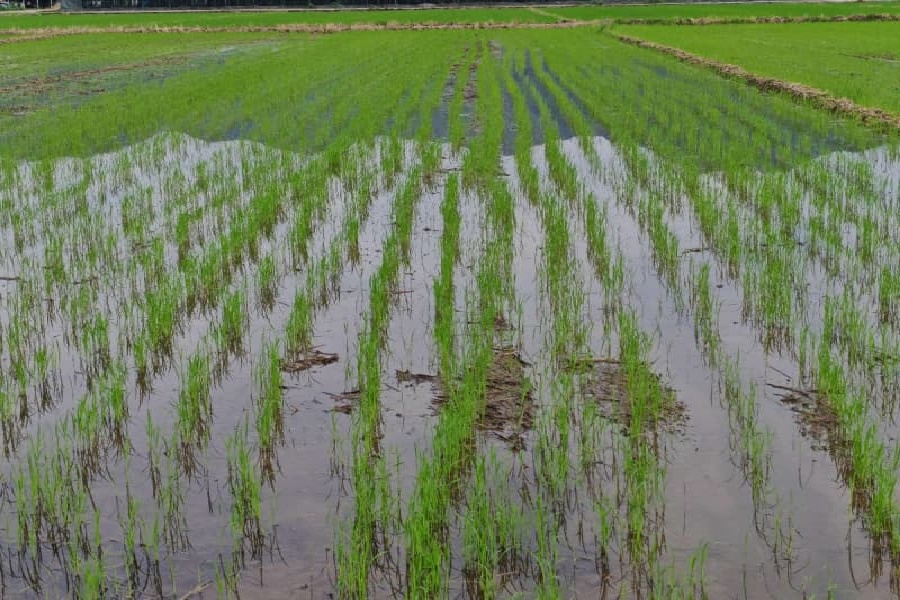
Field results, not renderings. Both photographs are from commercial rice paddies in China — one taken at seeding, one at tillering.
In 2024 a seeding-rate trial was run in Fuyang, Zhejiang in cooperation with a national rice research institute, sowing the same field at four rates: 1.5, 3.9, 6 and 8 kg per mu (about 22, 59, 90 and 120 kg/ha). Emergence counts taken a month later showed the 1.5 kg/mu rate — roughly 50% less seed than conventional broadcast seeding — still producing a full, evenly spaced stand.
A second site in Yixing, Jiangsu was followed through the whole season: sown 7 June, emergence 15 June, tillering in August, harvested 12 November. Mean tiller count at tillering was over 20 per plant, with the usual advantage along the edge rows.
What to look for: the rows are still there at tillering, so you keep a fixed spacing you can spray along and top-dress along. The tubes run 15 cm ± 5 cm above the soil, so seed lands where it is aimed instead of drifting in the rotor wash.
What we do not claim: a yield increase. Published trials comparing uniform spacing with broadcast seeding report no significant yield difference. The gain is in where the seed lands and how the crop stands — not in a bigger harvest. Trial references available on request.
1, Which drones are compatible with this row seeding module?
The module supports DJI Agras T55, T60, T70P, T70S, T100 and T100S, plus XAG P150 and P200 — as well as other compatible platforms. The number of modules is configured to your airframe and working width; send us your model and we will confirm.
2, How many seeding modules can be installed?
The system supports 4 to 6 modules.
3, What is the maximum seed capacity?
The maximum seed carrying capacity is approximately 50 kg.
4, Can the row spacing be adjusted?
Yes. Row spacing is adjustable between 25 and 30 cm to suit different crops and planting patterns.
5, How is this different from centrifugal broadcasting?
Instead of scattering seeds through centrifugal broadcasting, this system places seeds in controlled rows for more organized seed distribution.
6, Does the system support autonomous operation?
Yes. The system supports autonomous flight combined with manual seeding operation.
7, Can the system detect seed shortages?
Yes. It monitors both the tank level and the seed tube, and sounds an audible alarm before the tank runs empty or a tube stops passing seed.
8, What is the recommended flight speed?
The recommended flight speed is 4–7 m/s.
9, How close should the seeding outlets be to the ground?
The seeding outlets run 15 cm ± 5 cm above the ground — low enough to keep the seed in the row, high enough to clear uneven paddy surfaces.
10, Are you a manufacturer or a trading company?
We are a direct manufacturer with in-house R&D, production and quality control in Suzhou, China. OEM/ODM projects are welcome.
MOQ: 1 set (sample) / 5 sets (wholesale)
OEM / private label: quoted per project (housing, branding, packaging)
Documentation: third-party testing and export documents can be arranged for OEM/ODM projects
Lead time: 15-30 days after order confirmation
Warranty: 12 months
WillFly Drone is a direct drone payload manufacturer in Suzhou, China. We provide OEM/ODM services covering payload design, integration, customization and mass production. Contact us with your drone platform and application for specifications, pricing and delivery information.

We have recommended some of our Related products to you. I hope you will be interested.