Robot Dog for Industrial Inspection
Walk through any power plant, chemical facility or construction site at shift change and you will see the same routine: a technician with a clipboard, walking the same route, checking the same gauges. It works - until it doesn't. Rounds get skipped in bad weather, readings get copied from yesterday's sheet, and the one anomaly nobody walked past becomes next month's shutdown.
A robot dog - a four-legged robot that walks your site on its own - exists to close that gap. This page breaks down six places where quadruped robots are already doing inspection work, what they actually do on site, and how a ground robot and a drone work together as one inspection system.
Why Manual Inspection Rounds Fall Short
Human rounds have three structural problems:
Coverage gaps. A large site cannot be fully walked every shift, so checks are sampled, not complete.
Exposure. Some areas - high temperature zones, confined entries, live electrical rooms - put people at risk just by being checked.
Inconsistent records. Visual observations vary from person to person and day to day, which makes trends hard to trust.
Cost at scale. Adding coverage means adding headcount, on every shift, forever.
A quadruped robot attacks all four at once: it runs the same route every time, enters areas people should not, records consistently, and works around the clock without adding shifts.
What a Robot Dog Actually Does on Site
Forget the demo videos of robots dancing. On an industrial site, a inspection robot dog does four concrete things:
Walks programmed routes autonomously - including stairs, ramps and broken ground - and returns to its charging dock when the route is done.
Collects data at every stop - stabilized video, thermal readings and instrument readings from the same position every visit, which is what makes before-and-after comparison meaningful.
Flags anomalies in real time - an abnormal gauge reading, a hot bearing, a door left open - so a human is called in only when there is something to see.
Takes remote control when needed - an operator can drive the robot manually from a control room to investigate an alarm, seeing and hearing what is happening without walking there.
The payload set is what turns walking into inspection: optical and thermal cameras, gas sensing, microphones and two-way audio are all mounted on the same quadruped platform and configured flexibly per project.
6 Real Use Cases
1. Power plants and substations
The most mature application. The robot reads gauge values and indicator lights, scans switchgear and busbars with a thermal camera, and compares each reading against the previous run. Substation rounds that took a technician two hours on foot run continuously in the background, including at night.
2. Manufacturing floors
Production halls use the robot for equipment health checks - temperature and vibration anomalies on motors, pumps and compressors - plus a daily visual pass for leaks, worn belts and blocked walkways. Because readings are taken from the same spot each run, maintenance gets real trend lines instead of anecdotes.
3. Chemical and oil & gas facilities
Hazardous-area rounds are where four legs beat wheels and humans alike. The dog handles gravel, grating and stair towers while carrying gas detection payloads, keeping people out of the zone for routine readings and sending in the robot first when something smells wrong.
4. Construction sites
Progress and safety walks: the robot records the same camera positions daily so project managers can see week-over-week progress, while AI detection flags missing helmets, unplanned hot work and unauthorized night entry.
5. Perimeter and site security
As a patrol unit, the robot walks the fence line and dark zones on schedule, with two-way audio to challenge intruders and thermal cameras that keep working in rain and full darkness. It does not replace guards - it removes the 3 a.m. solo walk that guards dread.
6. Tunnels, pipe racks and utility corridors
Confined, long and boring - the three traits that make a route perfect for automation. Cable tunnels and pipe racks get a thermal pass for hot joints and a visual pass for seepage and corrosion, with the robot working through air that people would rather not breathe.
Pairing the Dog with a Drone: Ground + Air Coverage
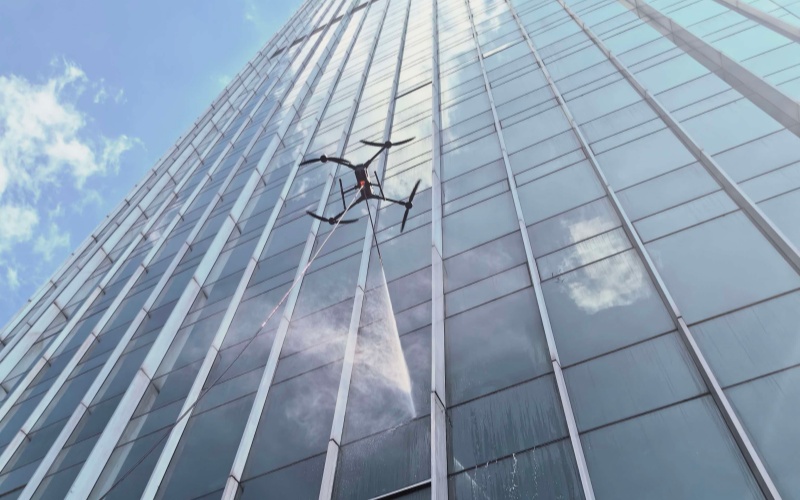
A ground robot covers what is at arm's reach - gauges, valves, skids, cable trays. It cannot judge a rooftop solar array, a flare stack or a 40-meter facade. That is the drone's job. WillFly Drone supplies the aerial half of this pairing: AI recognition systems and cleaning and inspection payloads that mount under DJI industrial platforms, with more than 1,000 units delivered to customers in 30+ countries since 2016.
The combination is straightforward: the dog walks the plant floor on schedule, the drone flies the vertical and hard-to-reach assets on schedule, and both feed their findings to the same operators. Neither replaces the other - sites that deploy only one always end up planning for the second.
What It Takes to Deploy One
Deployment is a configuration exercise, not a construction project. The robot is delivered as a working unit - MOQ 1, lead time 15-30 days, 12-month warranty - and the route, inspection points, payload mix and reporting format are set up against your actual site layout. For a single facility, plan on starting with one robot and one route, proving the data is useful, then extending routes rather than buying a fleet on day one.
FAQ
Can it climb stairs and handle rough ground?
Yes - the quadruped leg design is the whole point. Stairs, ramps, gravel, cable-tray floors and door thresholds are standard terrain for a legged platform, which is exactly why wheeled patrol robots fail where these units succeed.
Does it run fully autonomously or by remote control?
Both. Scheduled routes run autonomously and dock to recharge on their own; an operator can take over manually at any time from the control room to investigate an alarm. The usual pattern is autonomous rounds with human takeover only when the robot - or a person - sees something.
Which industries get the most value first?
Power and substations, chemical and oil & gas, and large manufacturing sites see the fastest payback, because their inspection routes are long, repetitive and partly hazardous - the profile where automated rounds beat manual ones immediately.
What is the MOQ and delivery time?
MOQ is 1 unit, lead time is 15-30 days after order confirmation, and the warranty is 12 months. Payload configuration is confirmed at quotation based on your site and inspection points - tell us your facility type through the contact page and we will put a configuration together.