DJI FC100 Solar Cleaning Payload
Dust, bird droppings and salt stains accumulated on solar panels reduce power generation efficiency by 10%-30%, leading to steady revenue losses for solar farms. Traditional manual cleaning has many drawbacks: high labor cost, fatal high-altitude risks, huge water waste, easy panel damage and poor management. Exclusively designed for the DJI FlyCart 100 drone, our FC100 solar cleaning payload fixes all these issues, supporting intelligent maintenance for ground solar farms, rooftop PV and agrivoltaic projects.
Why Panel Cleanliness Decides Power Output
A photovoltaic cell only produces electricity when sunlight reaches its surface. Every layer of dust, pollen, bird droppings or salt crystal sitting between the sun and the cell blocks part of that energy. In dry and dusty regions, or near coastal sites where salt fog leaves a sticky film on the glass, soiling builds up quickly and the loss compounds day after day.
Beyond the visible yield drop, uneven dirt patches can create hot spot defects: shaded cells heat up while the cells around them keep working, which accelerates module ageing and can cause permanent damage. Regular, uniform cleaning is therefore not cosmetic maintenance. It is a direct protection of the asset's output and service life.
Manual crews can restore cleanliness, but at a price that grows with every project: more workers, more hours on the roof, more water trucks. This is exactly the gap the FC100 cleaning payload was built to close.
5 Main Pain Points of Manual Solar Cleaning
1. High cost & low efficiency. A manual team moves panel by panel, bucket by bucket. Output per worker stays low while wages, insurance and site management costs keep rising, especially on large ground farms where rows stretch for kilometres.
2. Serious safety hazards. Rooftop and elevated cleaning means working at height all day. Falls and electric shock near live cabling are two risks that harnesses alone can never fully remove.
3. Massive water consumption & poor terrain adaptability. Manual washing wastes water through open hoses, and crews struggle on sloped mountain arrays, in agrivoltaic stations where crops grow between the rows, or on soft ground where water trucks cannot drive.
4. Uneven cleaning & permanent panel damage. Hand pressure varies from worker to worker. Wrong tools or rough pads leave scratches and microcracks, and uneven results let hot spots return within weeks.
5. No intelligent digital management. Paper checklists and scattered photos make it hard to prove what was cleaned, when, and to which standard, a recurring dispute between plant owners and O&M contractors.
How the FC100 Payload Solves These Problems
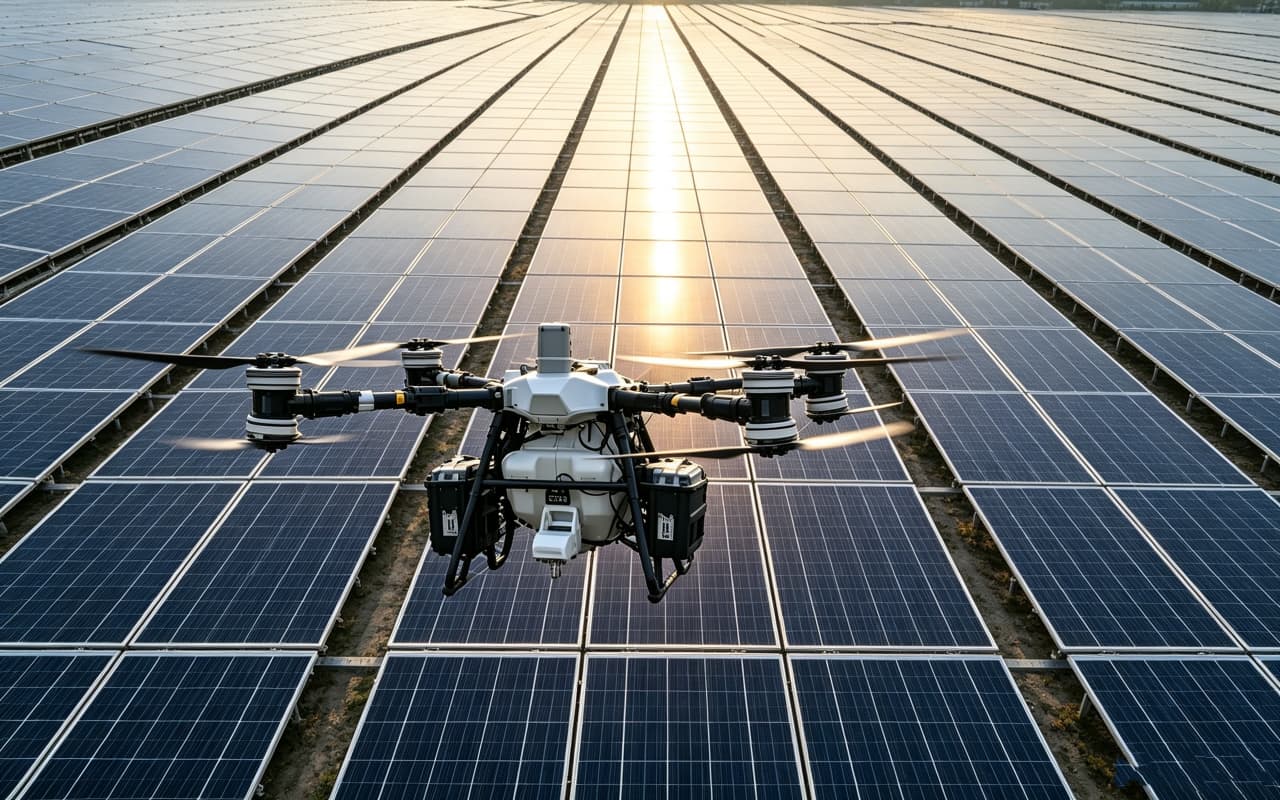
1, Cut labor cost & boost cleaning efficiency. The payload weighs under 8kg without the water tank and mounts through a 1/4 quick-disconnect interface, so installation takes minutes. One drone equals 15-20 workers, saving over 60% labor expenses. A single operator on the ground covers rows that would otherwise need a full crew, and mobilization for a new site shrinks from days to hours because there is no scaffold to build and no lift to rent.
2, Zero high-altitude operation risks. All operations are remotely controlled on the ground. No scaffolding or lifting equipment is needed, so fall and electric shock risks are eliminated from the work order entirely. The pilot stays metres away from the panels while the drone flies the cleaning path.
3, Water-saving design fits all complex scenarios. The 80L water tank with triple nozzles cuts water consumption by 80% compared with open-hose washing. Four interchangeable nozzle angles (0°/15°/25°/40°) let the operator match the jet to the job: a flat pattern for loose dust, angled jets for coastal salt corrosion. Less water on site also means smaller support vehicles and easier access to tight terrain.
4, 10-15MPa adjustable high pressure: deep cleaning without panel damage. Dual 2500W pumps support stepless adjustment of pressure, flow rate and swing angle. The operator dials pressure up for stubborn soiling and down for delicate sections, achieving a cleaning rate above 98% while effectively preventing hot spot defects.
5, PSDK linkage + 5G cloud for 24/7 unattended O&M. Native DJI PSDK communication ensures real-time data synchronization between payload and drone. Managers can assign cleaning tasks and check reports remotely via the cloud platform, giving multi-site owners one unified dashboard instead of scattered paper records.
Core Specifications
1, Net weight (without tank): <8kg — this leaves most of the FlyCart 100's payload budget for water, so every flight carries more cleaning time.
2, Pressure: 10~15MPa | Dual 2500W water pumps
3, Flow: 5~20L/min | Electric swing angle: 5°~65°
4, Nozzle angles: 0°/15°/25°/40° interchangeable
5, Protocol: DJI PSDK | Water tank: 80L
6, Mount: 1/4 quick disconnect — swap between missions in minutes without any drone modification.
What a Typical Cleaning Mission Looks Like
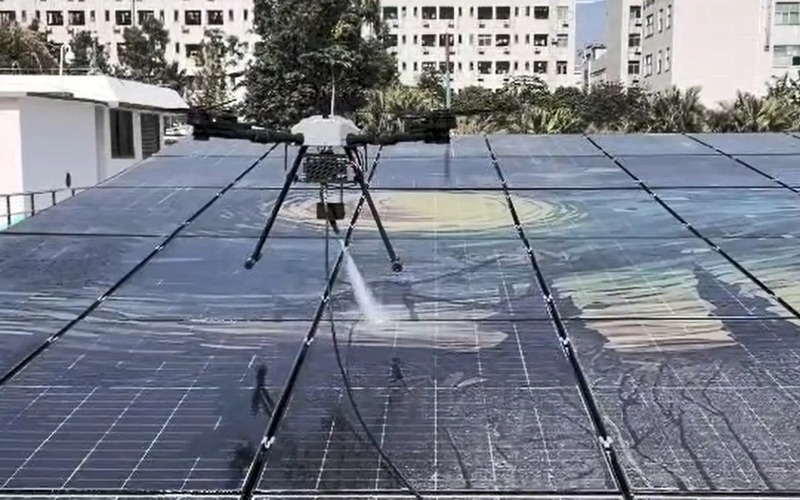
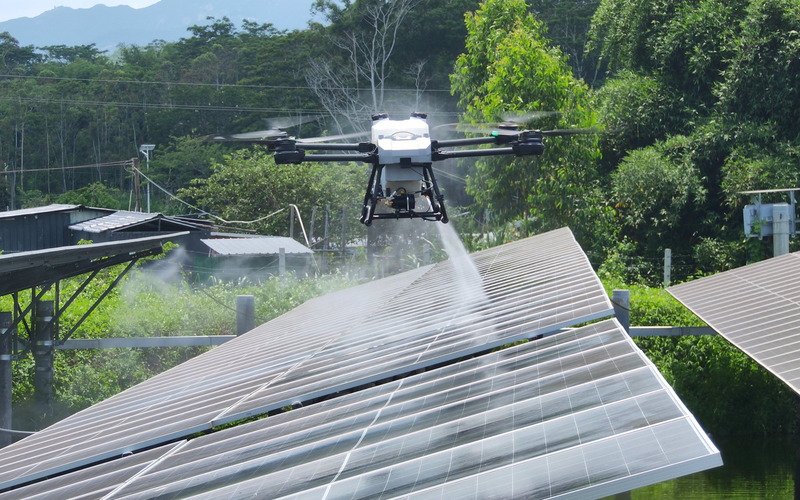
In the field, a mission runs in five steps. The crew mounts the payload on the FlyCart 100 through the 1/4 quick-disconnect interface and fills the 80L tank. The operator selects the nozzle angle that matches the soiling and presets pressure within the 10~15MPa range. The drone then flies a cleaning path along the panel rows while the operator fine-tunes swing angle and flow rate in real time. When the tank runs low, the drone returns for a refill. Back at the office, the manager opens the cloud platform to review the task report, so every cleaning round leaves a traceable record instead of a folder of photos.
What to Check Before Upgrading Your Fleet
Payload budget: confirm your drone's spare capacity. At under 8kg without the tank, the FC100 payload keeps room for water, which is what actually does the cleaning.
Pressure range: a fixed-pressure washer forces you to choose between stubborn soiling and delicate panels. Stepless adjustment across 10~15MPa removes that trade-off.
Water logistics: look at tank size and consumption together. An 80L tank with 80% water savings changes how much support equipment a site needs.
Integration: native DJI PSDK means the payload reports through the drone's own data channel, so cloud task management works without extra hardware.
Swap speed: the 1/4 quick-disconnect mount lets one airframe switch between missions in minutes, which matters when the same drone handles other work at different times.
Where It Works Best
Utility ground solar farms: long straight rows suit drone passes perfectly, and one operator handles what used to require a small army.
Commercial rooftop PV systems: the drone reaches panels above walkways, skylights and rooftop units that block manual carts, with no roof access ladders needed.
Agrivoltaic stations: cleaning happens above the crop zone, so the ground crew never walks through planted rows.
Coastal salt fog sites: the salt film is washed off before it etches the glass, and the 80% water saving matters most where fresh water is scarce.
Mountain sloped PV arrays: terrain that stops trucks is no obstacle for a flying platform.
Not sure how to match pressure, flow and nozzle angles to your own site? Our solar panel cleaning configuration guide walks through the setup decisions step by step. For a broader comparison of drone cleaning versus manual work, see our analysis on efficiency and safety.
FAQ
Q1: Which drones does the payload support?
A1: It is built for DJI FC100 and T100 platforms with native PSDK linkage and a quick mount, so no drone modification is required.
Q2: How much can power output increase after cleaning?
A2: A 10%-25% power efficiency improvement is typical after removing light-blocking contaminants.
Q3: Will high-pressure water damage photovoltaic panels?
A3: All parameters are adjustable. Proper nozzle matching ensures gentle yet effective cleaning without scratches or microcracks.
Q4: How is the payload installed?
A4: Through the 1/4 quick-disconnect mount. Installation takes minutes and needs no change to the drone itself.
Q5: Can cleaning work be monitored remotely?
A5: Yes. DJI PSDK communication and the 5G cloud platform let managers assign tasks and check reports remotely for multi-site unified management.
Q6: How much water does one flight use?
A6: The 80L tank with triple nozzles cuts water consumption by 80% versus manual washing. Actual coverage per flight depends on the soiling level and the pressure settings chosen.
Conclusion
Traditional manual cleaning cuts down solar farm profits constantly. The DJI FC100 solar cleaning payload replaces dangerous manual work with drone automatic cleaning, featuring safety, water conservation and cost reduction. It is the ideal upgrade solution for all PV operation & maintenance companies.
Full parameters and quotations are available on the FC100 solar panel cleaning payload product page. Contact us to get the technical catalog and field test videos.