Drone Window Cleaning Cost per Square Meter
Every property manager and cleaning contractor asks the same question first: what does facade cleaning actually cost per square meter? It is the number bids are won and lost on. This article pulls together published market rates, explains what pushes the price up or down, and shows how a drone-based setup changes the math. It is Part 3 of our cost series - read startup costs (Part 1) and hidden equipment costs (Part 2) for the full picture.
Published Market Rates per Square Meter
Benchmark numbers vary by country, but public industry guides land in a recognizable band:
Rope access (abseiling) window cleaning: commercial market guides in Australia quote roughly $3-6 per square meter for standard high-rise work, or day rates of $1,200-1,800 per team when buildings are large or access is tricky.
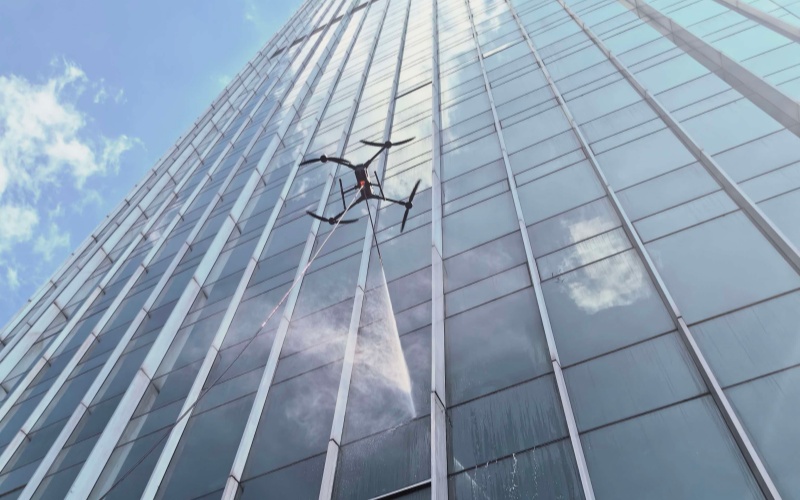
Drone-based facade cleaning: in China, where drone cleaning has scaled fastest, published service rates for ordinary high-rise glass run at roughly half the conventional rope-access rate, because the work simply moves faster on large, flat curtain walls.
Compared with scaffolding or boom lifts: rope access itself already saves 30-50% versus scaffolding on typical buildings - drones attack the same cost drivers (setup time, crew size, disruption) one step further.
Treat any single number you read online as a midpoint, not a quote. Two buildings in the same city can differ by a factor of two or more.
What Pushes the Price per Square Meter Up or Down
Height. More height means more safety overhead for crews, and it is where drone access saves the most time.
Facade material and geometry. Flat glass curtain walls are the cheapest per square meter. Curved glass, deep mullions, louvers and recessed windows slow any method down.
Dirt level. First cleans with cement haze, oil film or salt deposits cost far more than quarterly maintenance. Regular schedules cut per-visit rates by 15-25% in published provider guides.
Water access. If pure water and power are available on site, setup shrinks. If not, every liter has to be carried up or pumped - our M400 cleaning module works with an 80 m hose run from a ground source for exactly this reason.
Frequency and contract length. Annual contracts price lower per square meter than one-off jobs everywhere in the world.
Drone Cleaning vs Rope Access: Where Each One Wins
Honest comparison, because you will meet both on real projects:
Where drones win: large flat curtain walls, repeated maintenance cleans, buildings where suspending technicians over entrances or pedestrians is a problem, and jobs that must finish in tight time windows. A two-person drone crew with a DJI M400 cleaning module mounts up in about 5 minutes and sprays water or foam with a single remote controller plus app.
Where rope access still wins: complex curved facades, underside soffits, and detailed work around frames and seals. Most established operators use both - drones for area coverage, ropes for detail.
The practical takeaway for cost: drones raise the square meters per crew-day, which is the only lever that moves the per-square-meter floor price.
How to Estimate Your Own Rate
Build it bottom-up in four lines:
Floor rate = daily crew cost ÷ realistic square meters cleaned per day. Drone systems raise the denominator - that is the whole game.
Add consumables: purified water, detergent, batteries and wear parts. Part 1 of this series budgets $5,000-10,000 per drone per year for replacement parts and batteries.
Add equipment amortization: spread the payload and airframe investment over contracted square meters, not calendar months.
Add risk margin: first cleans, bad weather windows and difficult geometry eat margin fastest. Quote them explicitly instead of averaging them away.
Once your floor rate is known, everything above it is negotiation room - and with 1,000+ payload units delivered across 30+ countries, we see winning operators compete on reliability and repeat contracts, not on being the cheapest quote in the inbox.
FAQ
How do cleaning companies quote per square meter?
They multiply the floor rate (crew cost divided by daily output) by material, height and dirt-level factors, then adjust for contract length. Always ask what the quote includes - frames, sills and tracks are often charged separately.
Is drone window cleaning cheaper than rope access?
On large, flat curtain walls with regular cleaning schedules, published service rates in China run at roughly half of conventional rope-access rates because daily output is higher. On complex geometries, the two methods end up comparable, which is why many operators combine them.
Can a cleaning drone reach every part of a facade?
No method reaches everything. Drones cover flat and gently curved glass best; ledges, soffits and detailed edges still need rope access or extension tools. A mixed crew quotes honestly instead of promising full coverage with one method.
What equipment do I need to start offering per-square-meter drone cleaning?
A compatible airframe, a pressure-washing payload with stabilization and nozzle control, a water supply plan, and pilot certification for commercial operations. The WillFly team configures payloads per project - tell us your target buildings and we will spec the setup.
Part 1 covers startup costs and Part 2 breaks down hidden equipment costs - the three articles together give you a complete budget model for a drone window cleaning business.